AI Agents Versus RPA Tools: Which Fits?
Direct answer
AI agents versus RPA tools: learn where each fits, what breaks in production, and how to build controlled automation around real workflows at scale.
A bot that copies invoice fields between two stable systems is not an AI agent. An AI agent that interprets a contract, checks policy, asks for approval, and records the outcome is not RPA. Treating them as interchangeable is how businesses buy the wrong tool, automate the wrong step, and then wonder why the promised savings never show up.
The real question in AI agents versus RPA tools is not which technology is more advanced. It is whether the work requires deterministic execution, judgment across imperfect information, or both. Most established businesses need both. The hard part is placing each one behind the right controls.
AI agents versus RPA tools: the core difference
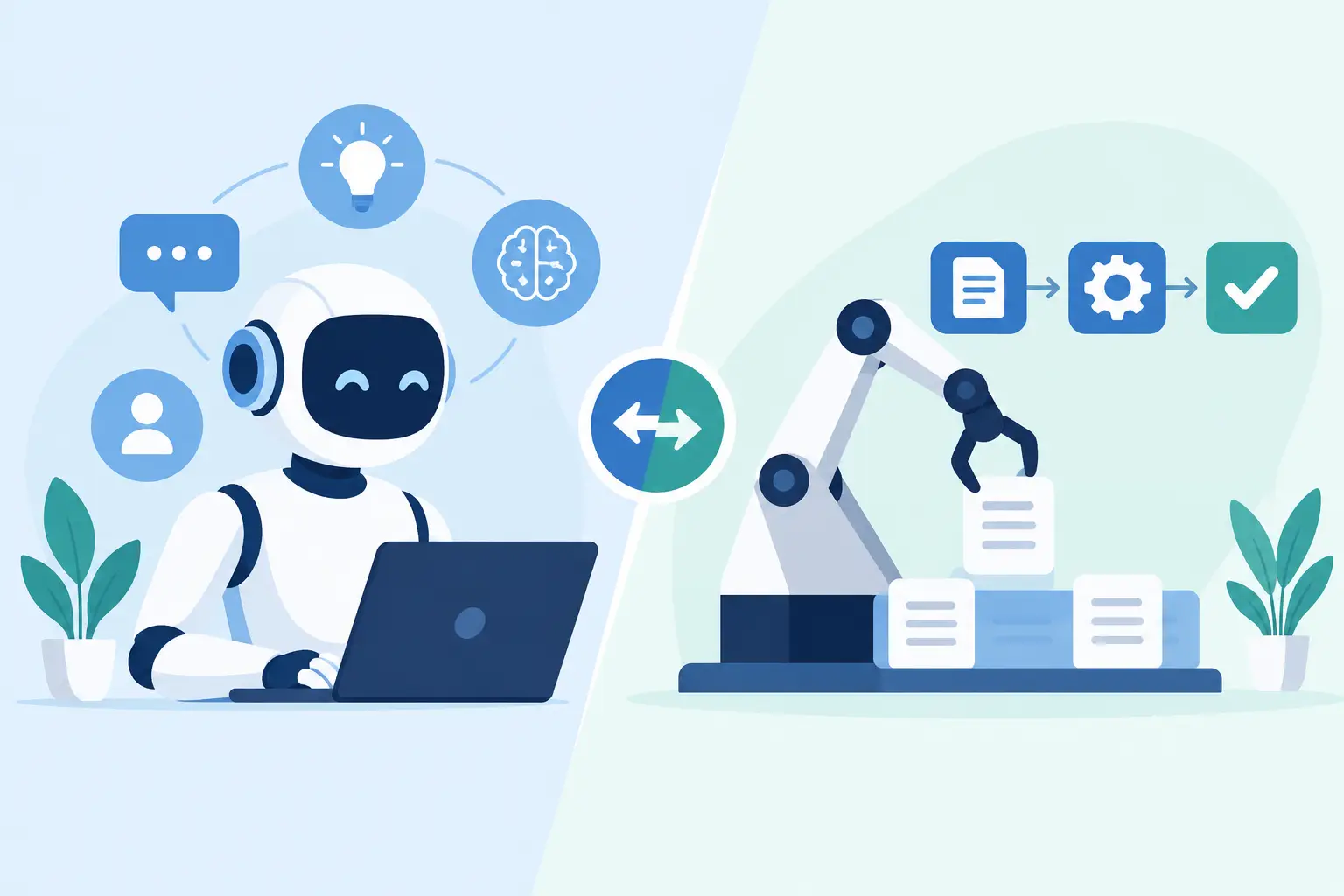
RPA, or robotic process automation, is built to follow defined instructions. It can log into systems, move data between fields, create records, download documents, and trigger actions based on rules. Give it a stable process, clear inputs, and predictable screens or APIs, and it can be fast and reliable.
AI agents operate differently. They use language models and connected tools to interpret context, retrieve information, decide what action to take within a defined scope, and sometimes ask a human to resolve uncertainty. They are useful when work arrives as emails, documents, conversations, tickets, images, or incomplete requests rather than clean rows in a database.
That difference matters because RPA is generally expected to do the same thing every time. An agent is expected to reason within boundaries, which means it requires evidence, evaluation, permissions, and escalation paths. It should not be given open-ended authority just because it can produce plausible language.
RPA is a process executor
A good RPA use case has a narrow, repeatable pattern. A finance team may need to collect daily reports from a supplier portal, reconcile fields against an internal system, and route exceptions to an analyst. If the inputs and rules are stable, RPA can remove repetitive clicks without changing the decision model.
The weakness is brittleness. A redesigned screen, changed field name, new exception type, or missing document can stop a bot. API-based automation is usually more durable than screen-based automation, but the underlying principle remains the same: RPA needs process consistency.
AI agents are bounded decision systems
A useful agent can read a supplier email, find the relevant purchase order, compare a requested change against policy, prepare a response with cited evidence, and send the case to a named approver. It handles variation that would create too many rigid branches in an RPA workflow.
But an agent is not a reliable authority by default. Language models can misunderstand a request, retrieve incomplete context, or state an answer confidently without adequate support. Production agents need access only to authorized data and tools. They need source-backed outputs, tests for known failure modes, audit logs, and human approval where the cost of a wrong action is material.
Where RPA tools are still the better choice
RPA is not obsolete. It is often the sensible answer when the job is repetitive, rules are explicit, and the cost of judgment is low. Replacing a well-defined automation with an agent adds variability without creating business value.
Consider employee onboarding. An RPA workflow can create accounts, add standard permissions, issue tasks, update an HR platform, and notify managers after a completed approval. It does not need to interpret company policy if each step is already determined by the employee type and location.
The same is true for high-volume back-office processing with structured inputs: copying validated order data into a legacy ERP, generating recurring reports, updating status fields, or reconciling records against fixed rules. RPA can be easier to test because expected outputs are deterministic.
The commercial test is simple. If a process can be written as a stable decision tree and its inputs are structured, start with conventional automation. Do not pay for probabilistic reasoning when a rule will do.
Where AI agents earn their place
AI agents become valuable when the work depends on interpreting unstructured information or coordinating across fragmented systems. Professional and operational businesses have plenty of this work: answering client questions, reviewing claim correspondence, qualifying inbound requests, preparing case files, triaging service tickets, or extracting obligations from contracts.
Take a property operations team handling maintenance requests. Messages arrive through email, a tenant portal, phone transcripts, and photographs. A controlled agent can classify the issue, identify the property and lease terms, search previous work orders, recommend urgency, draft communications, and create a task in the service platform. A human can approve high-cost repairs or safety-sensitive actions.
The agent does not replace the workflow. It makes the workflow usable when people are forced to read, search, compare, and rewrite the same information across disconnected systems.
This is also where generic chatbots fail. A chatbot may produce a convincing response, but it cannot safely operate inside a business unless it knows who is asking, what they are permitted to see, which sources are authoritative, and when it must stop. A production agent needs a named purpose and a permission limit, not a broad instruction to be helpful.
The practical answer is often both
The most durable designs combine AI agents and RPA tools around a clear division of labor. The agent interprets a request, assembles evidence, and determines the next permissible step. Conventional automation or an API then performs the repetitive transaction. A human approves actions that cross a financial, legal, safety, or customer-risk threshold.
For example, an accounts payable agent might read an invoice and supplier email, match them to a purchase order, identify discrepancies, and explain the issue with links to the underlying records. Once the invoice meets the approval policy, a workflow can post it to the accounting system. The AI handles ambiguity. The deterministic system handles the transaction.
This pattern reduces two common risks. First, it prevents RPA from becoming a tangled collection of exception branches. Second, it prevents an agent from being granted unrestricted access to business systems because nobody designed the handoff.
Do not choose technology before defining control
Buyers often begin with a vendor demo. That is backward. Start by mapping the work: where does the request originate, what information is needed, which systems are involved, who owns the outcome, and what happens when confidence is low?
Then define the operating controls before deployment. Every agent should have an identity, a bounded toolset, and an explicit data-access policy. Every customer-facing or consequential answer should be traceable to approved sources. Every workflow should include evaluation cases based on real failure patterns, not just happy-path demos.
This matters more in regulated or operationally complex businesses. An insurance servicing agent may be allowed to summarize a policy and draft a response, but not bind coverage. A legal operations agent may locate clauses and prepare a comparison, but not provide unsupervised legal advice. A manufacturing agent may interpret a quality report, but a qualified person should own disposition decisions.
The same discipline applies to measurement. Track more than chat volume or time saved in a demonstration. Measure resolution time, rework, escalation rate, exception rate, cost per completed case, and the rate at which users accept or override the agent's output. If the agent does not improve a real operational metric, it is not a production capability. It is a novelty layer.
A decision framework for the next workflow
Use RPA when inputs are structured, rules are stable, and the outcome is known before the work starts. Use an AI agent when inputs vary, relevant knowledge is scattered, and the work requires interpretation within defined boundaries. Use both when interpretation must lead to a repeatable system action.
There are cases where neither is the right answer. A broken process with unclear ownership should not be automated faster. A workflow that occurs twice a month may not justify custom engineering. A decision that depends on tacit expert judgment, with no reliable source material or review capacity, is not ready for autonomous handling.
TwoHundred.ai approaches this as an operating capability, not a catalog of bots. Build the shared layer once: knowledge access, integrations, identity, permissions, source attribution, evaluations, and approval controls. Then apply it to a small number of high-value agents with accountable internal owners.
The useful question is not whether your company needs AI or RPA. It is which part of a costly workflow deserves judgment, which part deserves deterministic execution, and where a person must remain responsible when the answer is wrong.
Related implementation paths
AI implementation services
Turn the article into a scoped first system with clear ownership, data, and measurement.
AI workflow automation
Automate one operational workflow inside the tools the team already uses.
AI agent development company
Design agents around jobs, tools, approval points, and measurable business outcomes.
Imraan, Founder of twohundred
Working through one of these decisions?
Book a 30-minute call. We will look at the specific workflow you are trying to put AI into, and what it would actually take to make it work in production.
Book a call