Agentic AI Is Only Useful When It Can Be Controlled
Direct answer
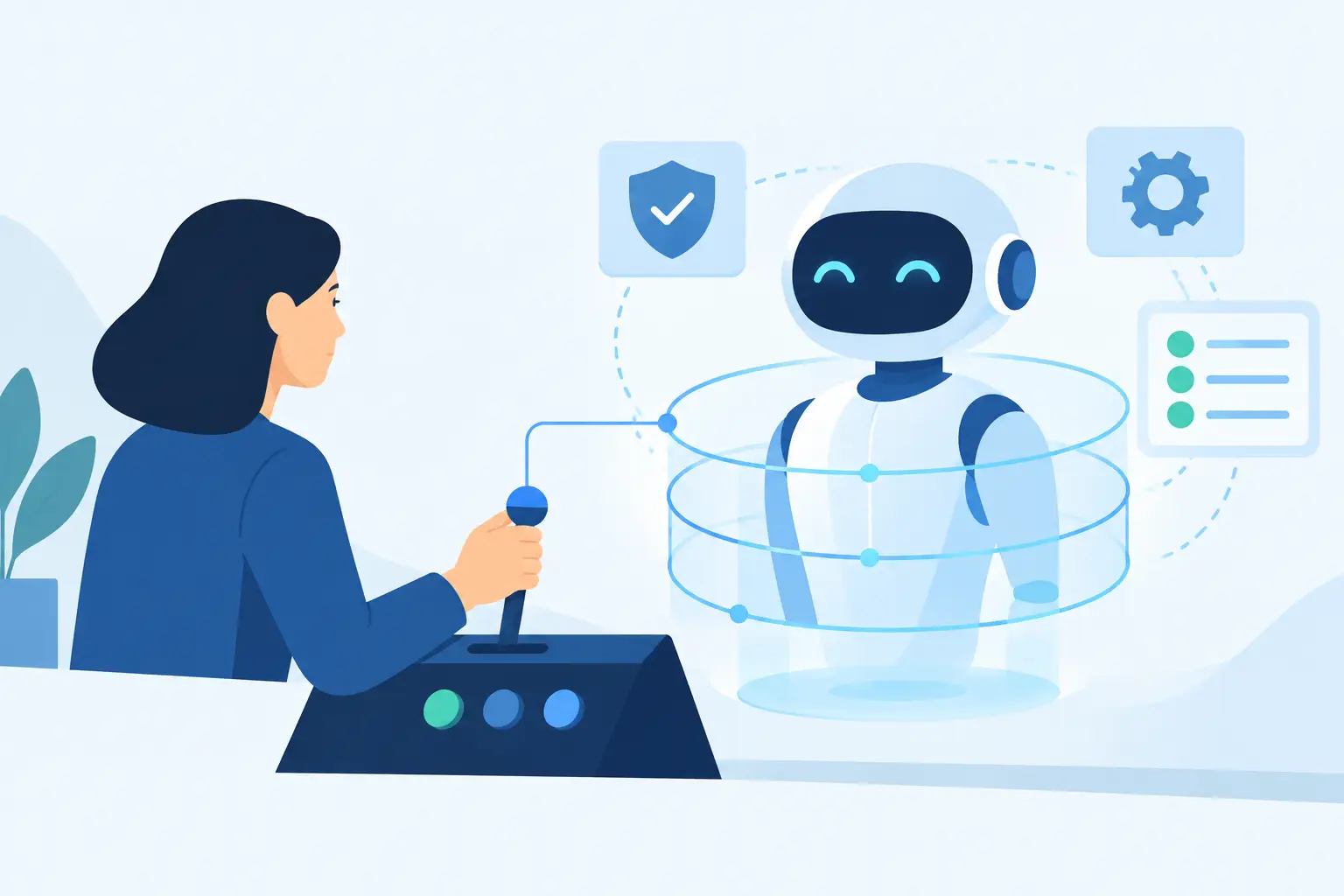
Agentic AI can automate real work, but only when it has governed data, permission limits, evaluations, and human approval built in across teams safely.
A model that can draft an email is not an operational system. Neither is a chatbot that can summarize a policy document when someone pastes it into a prompt. Agentic AI becomes commercially relevant when it can take a defined piece of work, access the right systems, make bounded decisions, and produce an outcome that your team can inspect and trust.
That distinction is where many AI initiatives fail. Companies buy licenses, run workshops, and build a prototype agent around a promising demo. Then the work stops at the point where it becomes difficult: connecting fragmented knowledge, enforcing permissions, handling exceptions, testing bad outputs, and assigning someone responsibility for the result.
The issue is not that the model is incapable. The issue is that the business has not built the operating layer around it.
What agentic AI actually means in a business
Agentic AI is software that uses an AI model to pursue a specific goal through a sequence of actions. It can retrieve information, call approved tools, interpret results, ask for missing inputs, prepare an output, and route work for human approval where required.
A useful agent has a job description. “Help employees” is not a job description. “Review incoming insurance submissions against underwriting rules, identify missing evidence, draft a broker follow-up, and submit the case for an underwriter’s approval” is one.
The difference matters because an agent is not simply a better interface for search. It is part of a workflow. That means it needs to work with the same constraints as the people it supports: data access rules, customer commitments, regulatory controls, quality standards, and escalation paths.
In a professional services firm, an agent might prepare a first-pass research brief from approved internal material and cited external sources. In logistics, it might investigate an exception by checking shipment status, carrier messages, inventory, and service-level commitments before proposing the next action. In construction, it might compare a change request against scope, drawings, prior approvals, and budget codes.
These are valuable applications. They are also high-risk if the agent has broad access, ambiguous instructions, or no reliable way to show its work.
The problem with isolated agentic AI pilots
Most failed agent projects are not failures of prompting. They are failures of architecture and ownership.
A department builds an agent using a standalone tool. It connects a few files, perhaps one application, and gives a small group access. The pilot looks good because the people testing it know the context and can spot mistakes. Then someone asks for access to the CRM, document repository, ticketing platform, or finance system. Another team wants its own version. A customer-facing use case follows.
At that point, the organization finds it has no shared answer to basic questions. Which source is authoritative? Who can see which records? What can the agent do versus merely recommend? How is an incorrect action detected? Who owns the agent after the consultancy leaves?
The usual response is to buy another tool or launch another pilot. That creates more disconnected knowledge stores, more credentials, more overlapping workflows, and more uncertainty about where decisions came from. You might have AI. You do not have value.
An agent that only works in a controlled demo is not production-ready. An agent that cannot explain the source of an answer is not suitable for critical work. An agent that can act without a clear permission boundary is an unmanaged operational risk.
Control is what makes an agent usable
Good agentic AI does not mean giving a model unrestricted freedom. It means defining where autonomy is useful and where it is not.
Start with identity. Every production agent should have a named purpose, a specific user group, and explicit tool permissions. A claims triage agent should not have the same access as a finance close assistant. A customer support agent should not be able to issue refunds simply because it can access order data.
Next, establish a source model. For knowledge-based outputs, the agent should retrieve from approved systems and show the relevant sources alongside its response. This is not cosmetic. Source attribution lets a user verify a recommendation, discover stale documentation, and challenge a conclusion before it causes a problem.
Then separate actions by consequence. It may be reasonable for an agent to draft, classify, route, and recommend with no human intervention. It may be reasonable for it to update a low-risk internal status after deterministic checks pass. It is usually not reasonable for it to approve a contract deviation, make a regulated decision, send a sensitive customer communication, or alter financial records without a defined approval step.
Human approval is not evidence that the implementation failed. It is a deliberate control. The right question is not, “Can the agent do this on its own?” The right question is, “What level of autonomy produces a meaningful speed or quality gain without creating unacceptable exposure?”
Build the foundation before multiplying agents
The fastest route to a second and third useful agent is not starting each one from scratch. It is building reusable infrastructure once.
That shared layer should connect the company’s knowledge sources and business tools, carry identity and permission rules into each interaction, log actions and outputs, and support evaluations. It should also give teams a consistent way to define approval flows and expose agents inside the systems people already use.
Without this foundation, every new agent becomes a custom integration project. With it, a new agent can reuse authentication, retrieval, source citation, tool access patterns, monitoring, and governance controls. The economics change because future delivery is faster and the risk surface is more visible.
This does not mean building a large internal AI platform before delivering anything. That approach can become another expensive transformation program with no operational result. Build the smallest shared foundation required for the first high-value agent, then extend it only when a subsequent use case justifies the work.
For example, a legal operations team may begin with an internal contract-intake agent that extracts key terms, identifies missing information, and prepares a review packet. The reusable elements are not limited to that workflow. Permission-aware retrieval, document processing, audit logs, approval queues, and evaluation datasets can support later agents for policy review, matter intake, or outside-counsel management.
Evaluate the failures before users find them
An agent cannot be considered ready because it produced a convincing answer ten times in a row. Models are probabilistic. Source systems are incomplete. Users phrase requests unpredictably. Real workflows contain exceptions that no happy-path demo reveals.
Evaluation turns this uncertainty into engineering work. Create test cases from actual business scenarios, including incomplete inputs, conflicting documents, inaccessible records, edge cases, and requests the agent must refuse. Define what a correct output looks like and what must never happen.
For a customer-facing agent, test tone and clarity, but do not stop there. Test whether it cites the correct policy, respects customer-specific entitlements, avoids inventing commitments, and escalates when the evidence is insufficient. For an internal agent, test whether it uses the correct source version, stays within its tools, and produces an audit trail that an operator can follow.
Evaluations should continue after launch. A change to a source system, permission model, prompt, tool integration, or model version can alter behavior. If nobody is watching output quality and failure patterns, the organization is relying on luck.
Choose work that justifies the investment
Not every process needs an agent. If a task occurs rarely, has little commercial impact, and requires extensive custom integration, automation may not be the sensible first move. A candid AI program should be willing to say so.
The best first candidates are repetitive, high-volume workflows where people spend time locating information, reconciling systems, preparing drafts, classifying requests, or chasing missing inputs. They have measurable friction and a defined owner. They also have a clear path to a decision, handoff, or completed action.
A useful starting question is: where does capable staff spend time moving information between systems or interpreting the same rules repeatedly? That is often where an agent can reduce cycle time without pretending to replace expert judgment.
TwoHundred.ai approaches this as embedded engineering, not chatbot installation. The goal is a named production agent on top of a foundation your team owns, with sources, permissions, evaluations, and approval controls designed into the work.
The practical test is simple: pick one workflow where an agent can earn trust through visible evidence. Give it a narrow mandate, connect it to the right data, measure the result, and keep a human accountable for the outcome. When that work holds up under real operating conditions, you have something worth scaling.
Related implementation paths
AI agent development company
Design agents around jobs, tools, approval points, and measurable business outcomes.
AI implementation services
Turn the article into a scoped first system with clear ownership, data, and measurement.
AI workflow automation
Automate one operational workflow inside the tools the team already uses.
Imraan, Founder of twohundred
Working through one of these decisions?
Book a 30-minute call. We will look at the specific workflow you are trying to put AI into, and what it would actually take to make it work in production.
Book a call