What Makes AI Outputs Reliable in Production?
Direct answer
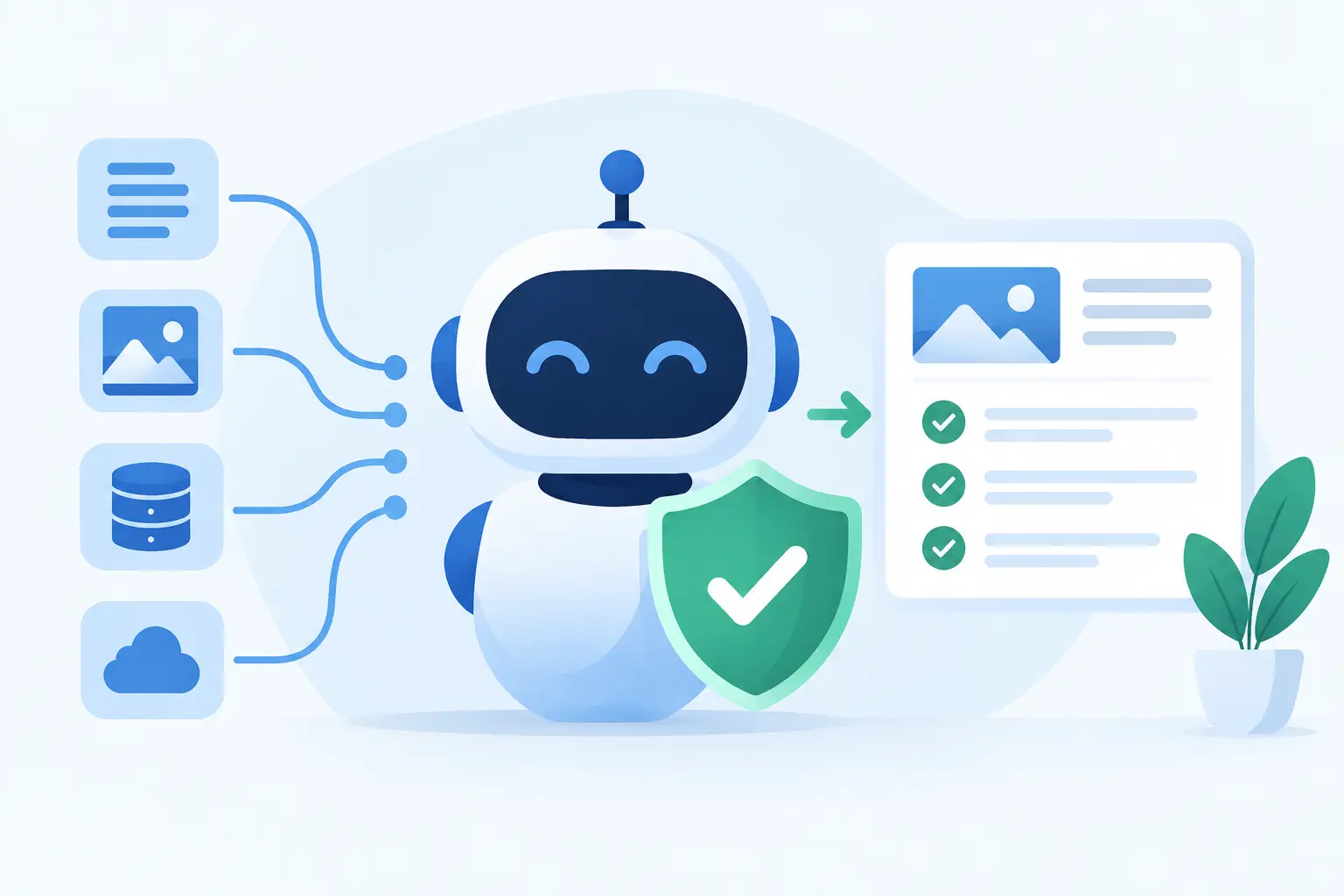
What makes AI outputs reliable? Source-backed answers, controlled permissions, evaluations, and human approval turn models into dependable systems daily.
A confident wrong answer can do more damage than no answer at all. It can send a claims team down the wrong path, expose sensitive client information, approve an incorrect supplier record, or give a customer a promise your business cannot keep.
That is the practical answer to what makes AI outputs reliable: not a better prompt alone, and not a model provider's latest benchmark. Reliability comes from the system around the model. The model generates language. Your architecture determines what it can see, what it can do, how it proves an answer, and when a person must intervene.
Businesses often discover this after a promising pilot fails in production. The demo knew the right answer because someone carefully supplied the document. The production agent faces stale files, conflicting policies, missing permissions, ambiguous requests, and users who assume every fluent sentence is factual. Those are not edge cases. They are the real job.
Reliable AI outputs start with bounded work
An AI agent should have a named job. “Help employees with anything” is not a job. “Answer procurement policy questions using approved policy documents” is. “Prepare a first-draft case summary from the authorized matter record” is. “Classify incoming maintenance requests and route them to the right queue” is.
A narrow scope is not a limitation to apologize for. It is how you make performance testable. If an agent has an undefined mandate, nobody can say whether it succeeded, which data it should use, or when it should refuse.
The same rule applies to actions. An agent that can read a knowledge base does not automatically need permission to alter a CRM record, send an email, issue a refund, or submit a bid. Read access, recommendation authority, and execution authority are different levels of risk. Treat them differently.
This is where many generic chatbot deployments fail. They place a powerful general-purpose model in front of fragmented company information, then call the result an assistant. The interface may look polished. The operating controls are usually missing.
Source-backed answers replace plausible answers
Language models are designed to produce useful continuations. They are not databases, policy engines, or systems of record. When the underlying information is absent, vague, contradictory, or out of date, the model can still produce a polished response. That is precisely the problem.
For knowledge-based work, every material answer should point back to an approved source. The user should be able to see the policy, contract clause, product specification, procedure, or customer record used to form the answer. If no reliable source is available, the agent should say so plainly.
Source attribution does more than reduce hallucinations. It changes behavior across the organization. Employees stop treating the agent as an oracle and start treating it as a faster route to evidence. Subject matter experts can challenge an answer against the source. Compliance teams can review what happened. Owners can see where knowledge is incomplete.
The quality of retrieval matters as much as the presence of retrieval. A shared folder full of duplicate PDFs, obsolete procedures, and unstructured notes is not a trustworthy knowledge system. Documents need ownership, version control, sensible chunking, metadata, and a clear definition of which source wins when two documents conflict.
Some questions should not be answered from documents at all. A user asking for a live account balance, inventory position, shipment status, or claim state needs a controlled connection to the system of record. The agent must retrieve current data through the appropriate integration, under the requesting user's permissions. Otherwise, it is merely summarizing a stale snapshot.
Permissions are part of answer quality
An answer can be factually correct and still be unacceptable because the user was not entitled to see the information. Reliability includes confidentiality.
A production agent needs an identity, a defined permission boundary, and an auditable path to each source or tool it uses. It should not inherit unrestricted access because an administrator connected a company drive during setup. A recruiter should not be able to query compensation data. A project manager should not be able to retrieve legal advice from another client matter. A customer-facing agent should never expose internal notes because they happened to be nearby in a shared index.
This becomes more difficult in businesses with legacy platforms and years of uneven access practices. It is also why an AI rollout cannot be separated from identity, permissions, and data governance. The right answer for one employee may be an access violation for another.
When a model can take action, apply the same discipline to tools. Give it the minimum permissions required for the task. Log every action. Require confirmation before irreversible or high-impact steps. The goal is not to remove human judgment everywhere. It is to reserve human judgment for the decisions where it matters.
What makes AI outputs reliable is evaluation, not optimism
Most organizations test AI informally. A few leaders ask a few questions, the answers sound good, and the pilot moves forward. That is not testing. It is a product demonstration.
Reliable systems are evaluated against real work. Build a test set from representative requests, including the awkward cases that staff actually face: incomplete documentation, conflicting instructions, unusual terminology, requests outside scope, unavailable data, and attempts to obtain restricted information.
Measure more than whether the response sounds reasonable. A useful evaluation set checks whether the agent:
- selected the correct source and cited it accurately
- declined when evidence was missing or the task was outside scope
- respected the user's permissions
- used the right tool and avoided unauthorized actions
- produced an output that a qualified employee can use without extensive rework
The thresholds depend on the use case. An internal drafting assistant can tolerate more human editing than an agent that sends customer messages or updates financial records. A healthcare, legal, or insurance workflow may require stricter review than a low-risk internal search task. “Reliable enough” is a commercial and operational decision, not a universal number.
Evaluation also has to continue after deployment. Source content changes. APIs fail. Models are updated. Users find new ways to phrase requests. A system that passed testing in March may drift by June without anyone noticing. Production monitoring should capture answer quality, source use, refusals, tool failures, user corrections, and escalation patterns.
Human approval is a control, not an admission of failure
There is a persistent idea that an AI workflow is only valuable when it operates without people. That is how teams automate the wrong thing.
Human approval is appropriate when the cost of an error is high, when context is unavailable to the model, or when accountability must remain with a designated role. An agent can assemble evidence, draft a response, classify a case, calculate a recommendation, and prepare the next action. A person can approve the decision that changes a contract, affects a customer, or creates a legal commitment.
The approval step should be designed, not bolted on. The reviewer needs the proposed output, relevant sources, key assumptions, confidence signals where useful, and a simple way to correct or reject the result. Those corrections should feed back into evaluations and workflow design. If reviewers repeatedly fix the same issue, the system has exposed a defect worth addressing.
Over time, some steps may earn more autonomy. Others should remain under review permanently. The answer depends on risk, volume, reversibility, and the maturity of the underlying data. There is no prize for removing a human from a decision that still requires one.
Reliability needs an owner inside the business
An AI agent is not finished when it is deployed. Someone must own its purpose, source set, permissions, performance standards, and change requests. Without that owner, the agent becomes another neglected software asset: useful for a while, then increasingly unreliable as the business changes around it.
This is why isolated pilots rarely create durable value. Each new chatbot gets its own documents, prompts, integrations, and security assumptions. Maintenance multiplies. Nobody has a clear view of what the agents know or who they can affect.
A better approach is a shared AI foundation: one layer for company knowledge, identity, permissions, tool integrations, source-backed responses, evaluations, and approval controls. Individual agents can then be built for specific jobs without rebuilding these controls each time. Delivery gets faster, but more importantly, the standard stays consistent.
TwoHundred.ai builds this kind of foundation because production AI should become an operating capability, not a collection of impressive demos. The business keeps the code, the documentation, and the ownership. That matters when the next workflow needs to be built.
The useful question is not whether a model can generate an answer. It almost certainly can. Ask whether the answer is grounded in the right evidence, shown only to the right person, tested against real work, and routed to human judgment when the stakes require it. Build for those conditions first, and the speed of AI becomes something your business can actually trust.
Related implementation paths
AI implementation services
Turn the article into a scoped first system with clear ownership, data, and measurement.
AI workflow automation
Automate one operational workflow inside the tools the team already uses.
AI agent development company
Design agents around jobs, tools, approval points, and measurable business outcomes.
Imraan, Founder of twohundred
Working through one of these decisions?
Book a 30-minute call. We will look at the specific workflow you are trying to put AI into, and what it would actually take to make it work in production.
Book a call