Why Source Backed AI Answers Matter at Work
Direct answer
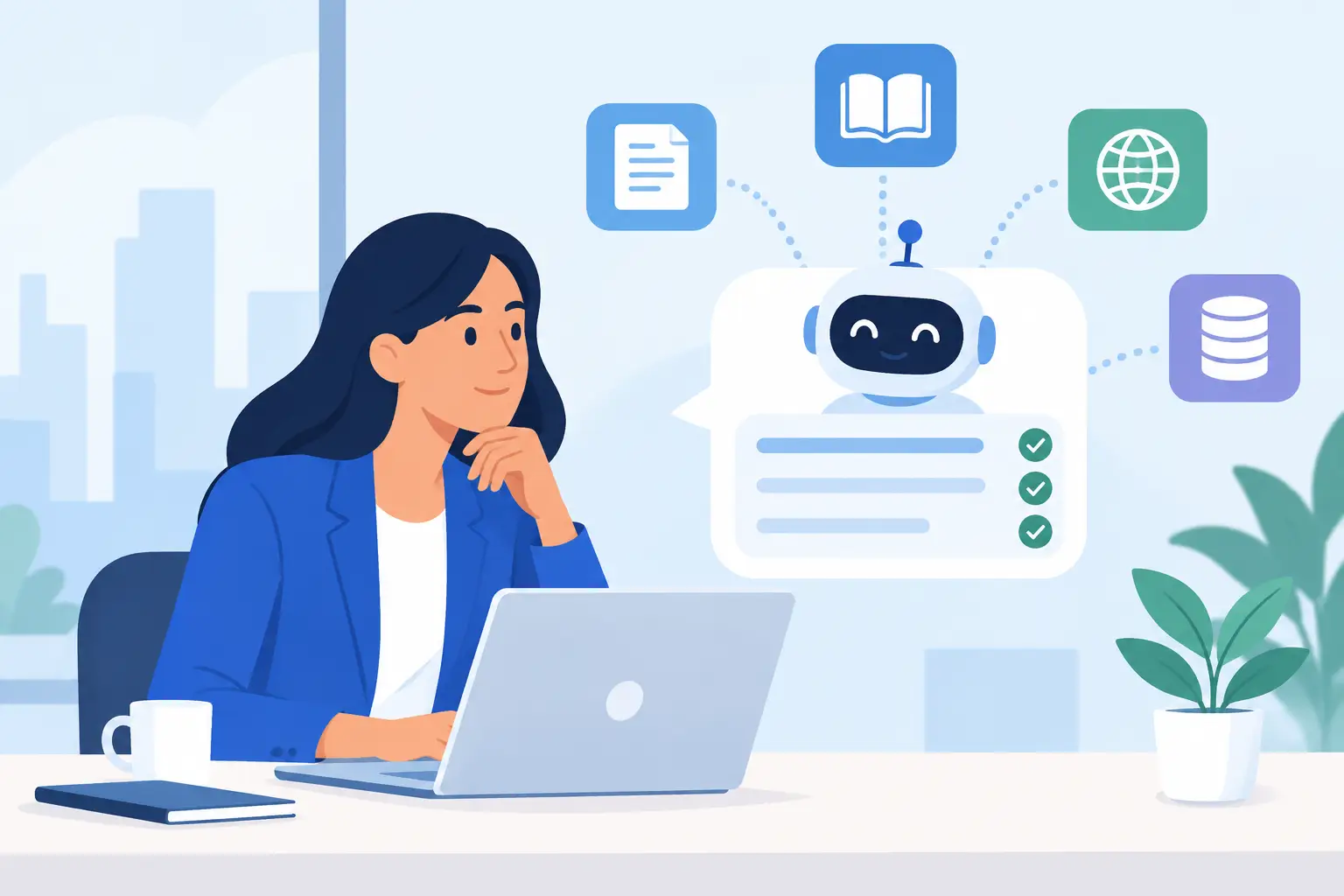
Source backed AI answers make agents auditable, useful, and safe enough for real operational decisions, not just impressive demonstrations for teams.
A polished answer with no evidence is not operational intelligence. It is an unverified claim delivered at speed. For a consumer query, that may be tolerable. For a claims decision, construction variation, client brief, policy question, or financial exception, it is a liability.
Source backed AI answers change the standard. Instead of asking employees to trust a model's confidence, the system shows where its answer came from: the approved policy, contract clause, project record, CRM entry, procedure, or live system data. That makes AI usable in the parts of a business where getting the answer wrong has a cost.
The problem is not that AI gets things wrong
Every useful technology has failure modes. The real problem is whether those failures are visible, measurable, and controllable.
A generic chatbot can summarize a policy document, draft a response, and sound entirely certain while citing a version that was replaced six months ago. It may combine a client-specific exception with the standard rule. It may answer a question that the user was not permitted to ask. None of this is unusual. It is what happens when an AI interface is placed on top of fragmented company information without retrieval rules, identity controls, and evaluation.
Many businesses call this an AI pilot. It is usually a search box with a model attached.
That approach produces a predictable result: employees try it, find one or two errors they cannot explain, and return to asking the person who knows where the spreadsheet lives. Leadership sees usage flatten and assumes the organization needs more training. It does not. It needs a system that can establish what is true, what the agent is allowed to see, and when the agent should decline to answer.
What source backed AI answers actually require
A citation at the bottom of a response is not enough. A web-style list of links can look credible while doing little to prove that the answer is grounded in the right information.
A production answer should identify the exact source or sources used, preserve enough context for a human to verify the claim, and respect the authority of that source. A signed client agreement should not be treated as equivalent to an old internal slide deck. A current controlled procedure should outrank an employee's personal notes. Live data should be labeled as live data, with its retrieval time and relevant filters clear.
This requires a shared foundation, not an isolated agent. At minimum, that foundation needs governed knowledge ingestion, metadata, versioning, retrieval logic, identity-aware permissions, tool integrations, evaluation datasets, and an audit trail. The agent also needs a defined job. "Help with anything" is not a job description.
Consider a legal or commercial operations agent asked, "Can we approve this customer request?" A dependable response should distinguish between the governing terms, the applicable account status, the request details, and any missing facts. If the answer depends on a manager's approval, the agent should say so and route the case accordingly. It should not invent a yes because a user asked a yes-or-no question.
That is less theatrical than a general-purpose chatbot. It is much more valuable.
Retrieval is only one control
Retrieval helps a model locate relevant information. It does not, by itself, guarantee a reliable answer.
The system must first decide which sources are eligible. Then it must retrieve the correct passages, account for document dates and ownership, apply user permissions, and instruct the model to answer only from the evidence provided. It must also handle weak evidence properly. Sometimes the best answer is: "I cannot confirm this from the approved sources." That is not a product failure. It is a controlled outcome.
For operational work, source priority matters as much as source relevance. A highly relevant obsolete document can be worse than no document at all.
Where the commercial value appears
Source attribution is often framed as a compliance feature. It is that, but the commercial case is broader.
First, it reduces verification time. A project manager does not need to manually search five folders to check an answer about scope. A service team can see the underlying account record and policy excerpt before responding. The AI handles the first pass; the human can validate the important detail quickly.
Second, it makes adoption more likely. Teams will not hand over meaningful work to a system they cannot challenge. Give them an answer with evidence, and they can judge it. Give them unsupported prose, and they either overtrust it or ignore it. Neither outcome improves the operation.
Third, it creates a feedback loop. When an answer is wrong, the team can inspect the source selection, retrieval behavior, permissions, prompt rules, and connected systems. This turns failure into an engineering issue with a fix path. Without sources, the conversation stays vague: "The AI said something strange."
The return depends on the workflow. For low-risk writing tasks, strict source requirements can add unnecessary friction. For decisions involving regulated data, customer commitments, pricing, safety, contractual obligations, or internal policy, the opposite is true. The cost of an ungrounded answer is usually higher than the cost of building the controls.
Build for the question, not the demo
The fastest way to waste money on AI is to start with a broad assistant and hope a use case emerges. Start with a repeated decision or information task where people already lose time, make avoidable errors, or depend on a small number of experts.
A useful scope names the users, decision, sources, systems, permission boundary, expected action, and escalation path. For example: an operations agent that answers approved delivery-status questions for account managers using the ERP, shipment records, and customer-specific service rules. That is testable. "An AI assistant for operations" is not.
Before deployment, build an evaluation set from real questions. Include straightforward queries, outdated-document traps, conflicting-source cases, permission tests, incomplete records, and questions the agent must refuse. Measure more than answer quality. Test whether the cited source supports the claim, whether the right version was used, whether unauthorized data stayed inaccessible, and whether the agent escalated appropriately.
This is where many one-off implementations fail. They test whether a demo looks good, not whether a system holds up under normal employee behavior.
Human approval is a design choice, not an admission of defeat
Some work should remain human-approved even when the agent is accurate. Customer-facing commitments, financial actions, high-value exceptions, and regulated decisions often need a person in the loop. The right design gives that person a compact evidence package rather than another inbox full of raw data.
Other tasks can be automated after the controls have proved themselves. The boundary should be earned through evaluation and monitoring, not declared in a workshop.
Each agent also needs a named owner inside the business. Someone must be accountable for source quality, policy changes, acceptance criteria, and the operational result. An external team can build the capability, but it cannot permanently own the business judgment behind it.
The standard worth adopting
Source backed AI answers are not about making every response look academic. They are about making AI accountable where accountability matters.
If an agent cannot show the evidence, it should not be the final authority. If it cannot respect permissions, it should not touch sensitive workflows. If it has not been tested against the ways your team actually works, it is not ready for customers or critical decisions.
The useful question is not whether your business has an AI tool. It is whether a manager can act on its answer, inspect its evidence, and know who owns the outcome. Build toward that standard, one defined production workflow at a time.
Related implementation paths
AI agent development company
Design agents around jobs, tools, approval points, and measurable business outcomes.
AI implementation services
Turn the article into a scoped first system with clear ownership, data, and measurement.
AI workflow automation
Automate one operational workflow inside the tools the team already uses.
Imraan, Founder of twohundred
Working through one of these decisions?
Book a 30-minute call. We will look at the specific workflow you are trying to put AI into, and what it would actually take to make it work in production.
Book a call