How to Secure AI Integrations Without Losing Control
Direct answer
Learn how to secure AI integrations with identity controls, least privilege, source-backed outputs, evaluations, and human approvals in production safely.
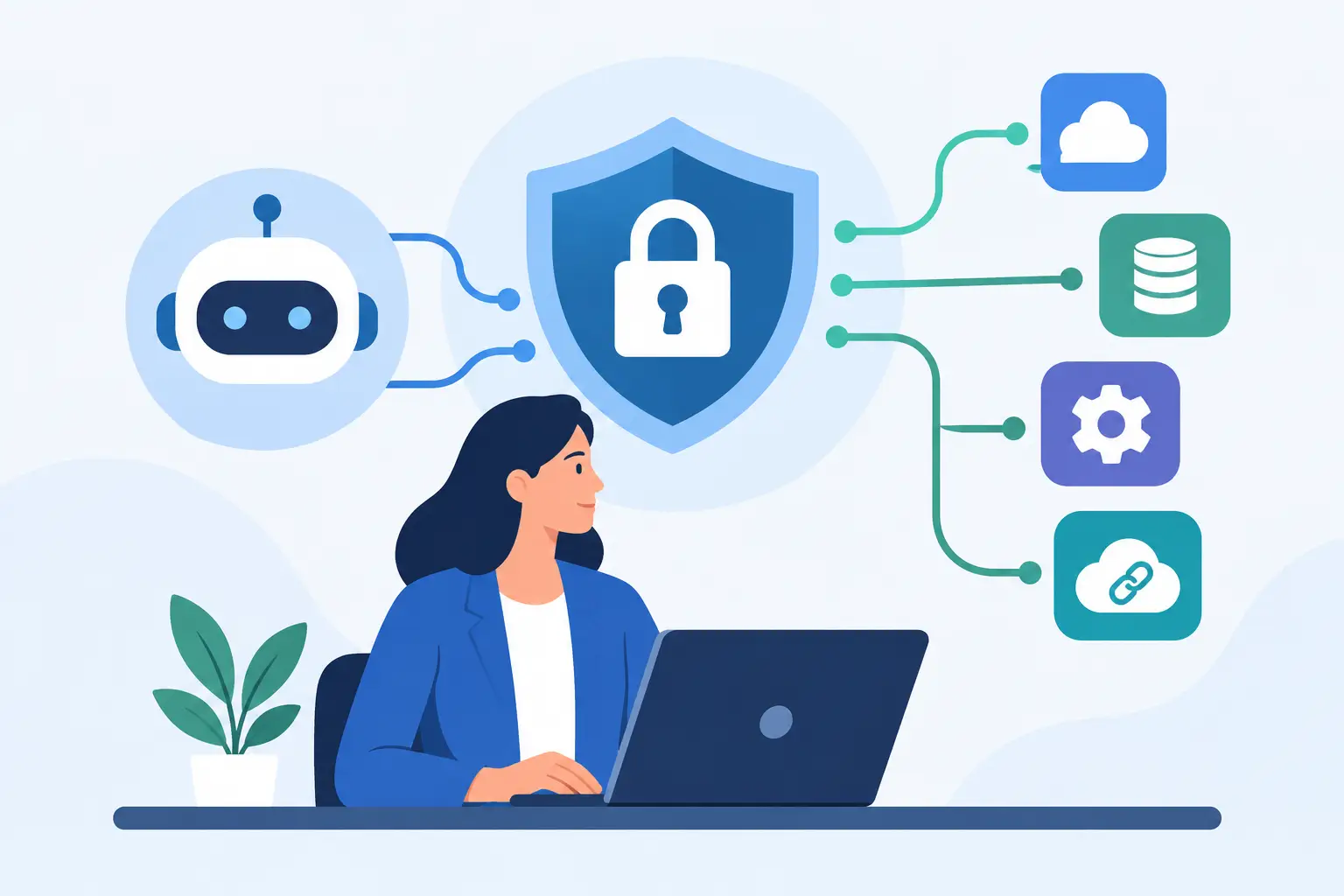
An AI assistant that can read a policy folder is one thing. An AI agent that can search customer records, draft a contract amendment, update a job status, or trigger a payment workflow is another. The second system is operating inside your business. That is why learning how to secure AI integrations starts with a blunt premise: the model is not the security boundary. Your systems, identities, permissions, and approval rules are.
Most AI security failures are not caused by a model suddenly becoming malicious. They happen because a team connected a capable interface to real tools without defining what that interface is allowed to know, do, or send outside the company. A clever prompt cannot repair an architecture that gives a general-purpose agent broad access to finance, HR, customer, and operational systems.
Treat every AI integration as a production identity
An integration should not inherit the permissions of the executive, developer, or service account that created it. It needs its own named identity, purpose, and scope.
If you deploy an agent to answer questions about active construction projects, it may need access to approved drawings, schedules, change orders, and site reports. It does not need access to payroll, executive correspondence, or every project in the company. The same principle applies to customer-facing agents. An agent helping a policyholder check claim status should retrieve only the records associated with that authenticated customer. It should not be able to search a broad claims database because the underlying tool makes that technically convenient.
This is least privilege applied to AI. The agent gets the minimum permissions required to complete a defined job. Not the permissions it might need later. Not the permissions a human administrator happens to have.
That requires a real identity layer. Each agent should have a service identity tied to a role, with access mediated by your existing identity provider or a controlled authorization service. Where a user asks the agent to take action, preserve the user’s identity and authorization context through the request. Do not turn every user request into an all-powerful backend call.
How to secure AI integrations at the tool boundary
The tool layer deserves more attention than the prompt. Prompts can express policy, but they are not enforceable controls. The system that executes a database query, creates a ticket, sends an email, or calls an ERP endpoint must independently validate that action.
Start by making tools narrow. A tool called `update_customer_record` is too broad if an agent only needs to change a delivery preference. Expose a purpose-built action that accepts a customer ID and one approved field. Validate the input server-side. Enforce authorization server-side. Log the result server-side.
Narrow tools reduce both accidental damage and attack surface. They also make testing possible. You can evaluate whether an agent should have changed a delivery preference. It is much harder to evaluate an agent with an unrestricted database write capability.
For any integration that changes a system of record, separate low-risk and high-risk actions. Drafting a support response can often be automated. Sending it may require review depending on the customer segment and the consequence of an error. Creating a purchase request may be acceptable within a fixed value limit. Approving a payment should not be delegated to a language model.
A practical control model usually has three paths:
- Read actions retrieve only authorized, relevant records and return source references.
- Low-risk write actions execute automatically within explicit constraints, such as status updates or internal ticket creation.
- High-impact actions require a named human approver before execution, including payments, contract changes, account closures, regulated communications, and external commitments.
The boundaries vary by sector. In healthcare, a seemingly simple message can become regulated patient communication. In legal services, a draft can create professional liability if it is presented as final advice. Security is not a generic checklist. It is a design decision tied to the workflow and its consequences.
Keep data retrieval separate from model judgment
A model should not be treated as a database. When it answers a question about company policy, a client account, inventory, or a contract, the system should retrieve the relevant approved source material at runtime. The answer should identify that source clearly enough for a user to verify it.
This improves accuracy, but it also improves control. You can determine which repositories are eligible for retrieval, apply permissions before content reaches the model, and exclude sensitive material by default. A source-backed answer is easier to audit than an answer generated from an unclear mix of training data, copied documents, and prior conversation.
Document-level permissions matter here. A shared drive may contain folders for all employees, restricted leadership material, and client-specific documents. Retrieval must respect those differences. Filtering after retrieval is weaker than filtering before it. The agent should never receive content it is not authorized to use.
Be equally careful with conversation history. Long-lived memory can be useful for a customer service agent or a case-management workflow, but it creates data retention and access questions. Define what is stored, where it is stored, who can retrieve it, and when it expires. If there is no operational reason to retain a conversation, do not retain it because the platform offers memory by default.
Defend against indirect prompt injection
Prompt injection is not limited to a user typing “ignore your instructions.” It can arrive inside the content your agent reads: a web page, PDF, email, support ticket, supplier document, or knowledge-base article. A malicious instruction hidden in a document may try to convince the model to reveal data, alter its objectives, or call a tool.
The right response is not to assume a better system prompt will solve it. Treat retrieved and external content as untrusted data. The agent can summarize it, extract facts from it, or cite it. It should not treat content from those sources as authority to change system instructions, reveal secrets, or take action.
Tool execution should also be explicit. Before an agent sends information to an external destination, creates a record, or performs a consequential action, the application should check intent, target, parameters, authorization, and approval status. For sensitive workflows, show the human the proposed action and the evidence behind it.
Test the failure cases before customers find them
A demonstration proves that an agent can work once. It does not prove it is safe to deploy. Production systems need evaluations that cover correctness, permission boundaries, unsafe tool calls, data leakage, refusal behavior, and escalation to a human.
Build a test set from actual business conditions. Include incomplete records, conflicting source documents, ambiguous requests, hostile inputs, users from different permission groups, and cases where the correct response is “I cannot do that.” Test every agent release against it.
Logging is part of the control plane, not an afterthought. You need a trace of what the user asked, which sources were retrieved, what tools the agent proposed or called, what permissions were applied, which model and prompt version ran, and whether a human approved the result. Do not log sensitive content indiscriminately. Apply retention limits and access controls to logs as well.
When an incident happens, the question should not be “What did the AI do?” It should be answerable with evidence: which identity acted, what data it could access, what policy allowed the call, and who approved the release.
Do not spread integrations across disconnected pilots
A company can deploy five useful-looking agents and still create a security problem if each one has its own credentials, retrieval rules, document index, approval logic, and monitoring. That is how access becomes impossible to audit and revoked permissions continue living in forgotten automation.
Build a shared foundation instead. Identity and permissions, knowledge retrieval, tool wrappers, evaluation harnesses, approval controls, and audit logging should be reusable services. Individual agents then become constrained applications on top of that foundation, not independent experiments with their own exceptions.
This does not mean centralizing every decision or delaying delivery until a perfect platform exists. Start with one high-value workflow. Put the common controls in place because the second and third agents will need them too. The trade-off is modest upfront engineering against a growing estate of systems nobody can safely govern. For established businesses, that trade-off is usually obvious.
Assign an internal owner before launch. Not a committee, and not an external vendor alone. A named owner should be accountable for business rules, source quality, access changes, evaluation results, and escalation paths. TwoHundred.ai builds these controls into production agents because handover without ownership is simply a delayed failure.
The useful question is not whether an AI integration is secure in the abstract. Ask what it can read, what it can change, what proof it needs before acting, and who can stop it when conditions change. If those answers are specific, your AI can earn a place in a real workflow.
Related implementation paths
AI implementation services
Turn the article into a scoped first system with clear ownership, data, and measurement.
AI workflow automation
Automate one operational workflow inside the tools the team already uses.
AI agent development company
Design agents around jobs, tools, approval points, and measurable business outcomes.
Imraan, Founder of twohundred
Working through one of these decisions?
Book a 30-minute call. We will look at the specific workflow you are trying to put AI into, and what it would actually take to make it work in production.
Book a call