Enterprise AI Knowledge Base: What It Must Do
Direct answer
An enterprise AI knowledge base connects trusted company data, permissions, tools, and evaluations so agents can answer and act with control at scale.
Most companies do not have a knowledge problem. They have a trust problem. Documents sit across SharePoint, Google Drive, CRM records, project systems, inboxes, and old databases. Employees can usually find an answer eventually. An enterprise AI knowledge base has to do more than make that search faster. It has to give an agent the right answer, from the right source, to the right person, with evidence.
That distinction is where many AI projects fail. A generic chatbot connected to a folder of files may look convincing in a demo. It is not a reliable operating system for client advice, financial decisions, claims handling, project delivery, or regulated workflows.
An Enterprise AI Knowledge Base Is Not a Document Chatbot
A document chatbot retrieves text and generates a response. It may be useful for low-risk internal questions, but it is only one component of a production system.
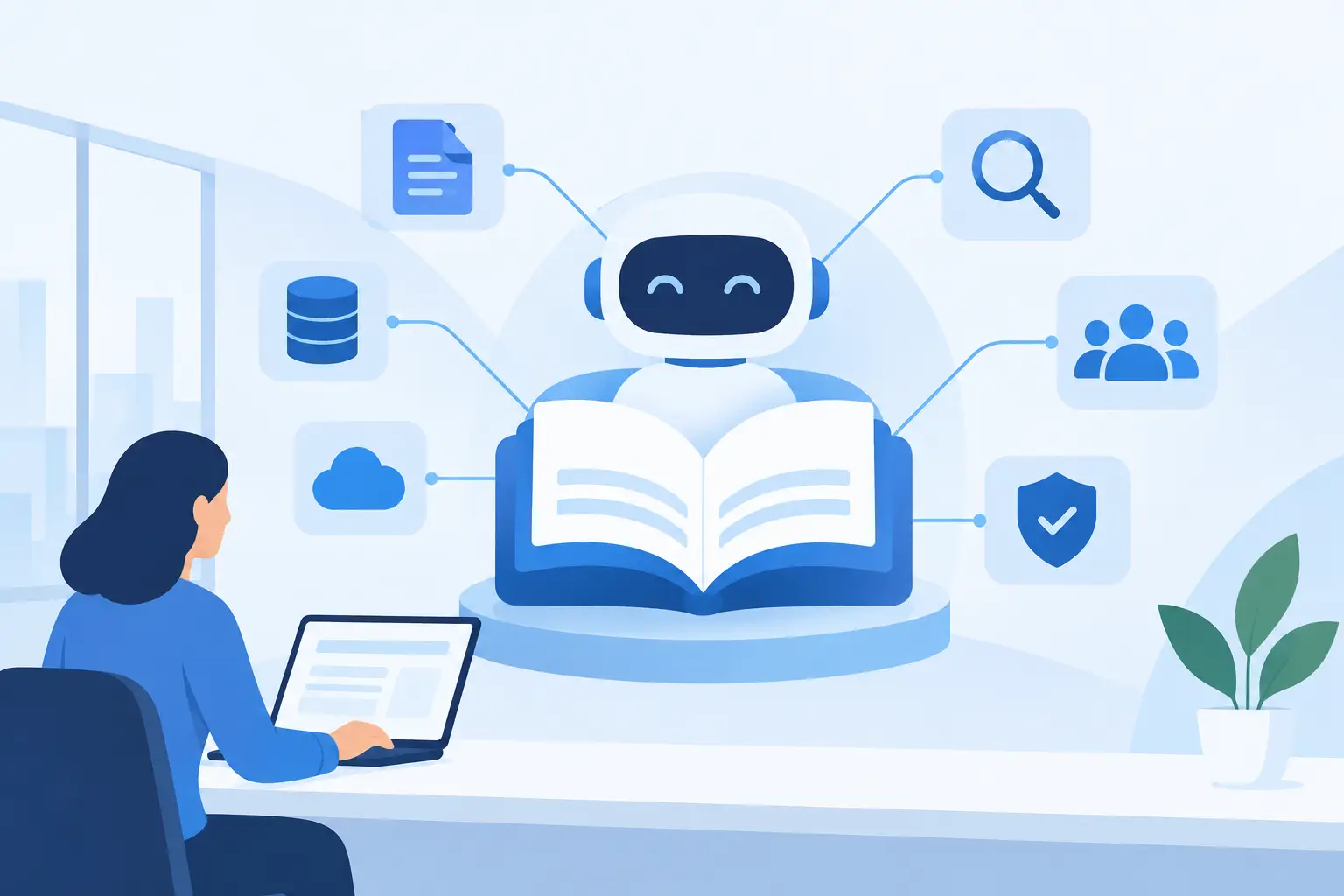
A real enterprise AI knowledge base is a controlled layer between company information and the agents that need to use it. It brings together structured records, unstructured documents, operational tools, user identity, and policy. It determines what the agent can retrieve, what it can act on, and when it must stop and ask a human.
This matters because the question is rarely just, “What does the policy say?” In practice, the question is more likely: “What does this customer’s contract permit?”, “Which supplier is approved for this site?”, or “Can I issue this refund under the current case status?” Those answers require live business context, not just a semantic search across PDFs.
The goal is not to centralize every file into one new repository. That migration is often expensive, disruptive, and unnecessary. The goal is to create a governed way for AI systems to access the sources that already run the business.
What the Foundation Must Control
An AI knowledge base becomes useful when it handles the controls that ordinary search tools ignore.
Source-backed retrieval
Every material answer should identify the records, documents, or systems that support it. Source attribution lets a user verify an answer quickly, but its value goes further. It gives teams a way to investigate errors, correct underlying content, and measure whether the agent is retrieving the right evidence.
“According to company policy” is not enough. A useful answer points to the applicable policy version, the relevant contract clause, or the current CRM record. If the agent cannot establish a reliable source, it should say so. Confident fabrication is worse than a visible gap.
Identity and permissions
Permissions cannot be an afterthought. A business may have a single policy library, but not every employee should see compensation data, legal advice, clinical records, pricing exceptions, or another client’s project information.
The knowledge layer needs to respect existing identity and access controls wherever possible. It must also define each agent’s scope. A recruiting agent can access candidate records but not payroll. A project delivery agent can read approved plans but cannot view board materials. A customer-facing assistant should not expose internal notes simply because they happened to be retrieved.
Permission design is not glamorous work. It is also the difference between a useful system and an incident waiting to happen.
Structured data and tool access
Many high-value answers live in systems that do not look like knowledge bases. They live in ERP tables, ticket queues, property systems, CRM objects, inventory records, and workflow states.
An agent should be able to distinguish between reference knowledge and live facts. A handbook may explain the travel policy. An expense system tells the agent whether a specific claim has been approved. A project archive explains how a prior issue was resolved. The current project schedule determines whether that approach is still viable.
The same boundary applies to actions. Reading a record is not the same as changing one. If an agent can create a case, draft a proposal, update a status, or trigger a payment workflow, the action needs a named permission limit and, where appropriate, human approval.
Evaluation and observability
If you cannot test an agent against known difficult questions, you do not know whether it is ready for production. A knowledge base needs an evaluation set drawn from real work: ambiguous requests, conflicting source material, outdated documents, permission boundaries, and questions with no valid answer.
Measure retrieval quality separately from response quality. An answer can be well written while grounded in the wrong document. It can retrieve the correct material but apply it incorrectly. These are different failures and require different fixes.
Operational logs matter too. Teams need to see what was retrieved, what tool calls were attempted, where an approval was requested, and why the agent refused. That is how AI becomes manageable rather than mysterious.
Start With a Named Decision, Not a Data Cleanup Program
The wrong starting point is, “Let’s connect all our knowledge to AI.” The scope is too broad, the risk is unclear, and the commercial case disappears into a long integration backlog.
Start with a decision or workflow that happens frequently, costs real time, and has identifiable source material. For a logistics company, that may be answering shipment exception questions. For an insurer, it may be preparing claim summaries against policy terms. For a professional-services firm, it may be assembling a first draft of client advice from approved precedents and current engagement records.
Then define what good looks like. Which sources are authoritative? Who is allowed to ask? What must the response cite? What should the agent never decide alone? Which mistakes are tolerable, and which are unacceptable?
This produces a smaller first agent, but a much more useful one. It also reveals the shared components worth building once: connectors, retrieval rules, access controls, evaluation harnesses, approval patterns, and audit logs.
Build for Reuse, but Do Not Generalize Too Early
There is a real tension here. A one-off agent is fast but creates maintenance debt. An enterprise platform program can consume a year before anyone sees value.
The practical middle ground is to build a production agent around one high-value use case while extracting the shared infrastructure it proves necessary. Do not create abstractions for hypothetical future teams. Do create reusable mechanisms when the first workflow requires them anyway.
For example, a contract-review agent and a sales-support agent may use different source collections and prompt logic. They should not necessarily be the same agent. But they can share identity controls, source citation conventions, document ingestion, evaluation methods, and logging. That shared layer reduces the cost and risk of the second, third, and tenth deployment.
This is the approach TwoHundred.ai applies when embedding engineers with client teams: build named production agents, then retain the foundation rather than leaving behind disconnected demos.
Common Failure Modes
The most common failure is treating retrieval as the entire problem. Better chunking and a more capable model will not fix stale records, conflicting policies, or users who should never have access to a source.
Another failure is loading uncurated content without ownership. If no team owns a policy library, precedent bank, or product catalog, the AI will expose the same inconsistency employees already face, only faster. Content governance does not need to become a large committee. It does need a named owner and a process for correcting high-impact material.
A third is deploying without a refusal path. Agents need permission to say, “I cannot verify that from approved sources,” or “This requires a manager’s review.” Teams often see that as a limitation. In critical workflows, it is a control.
Finally, do not confuse user adoption with reliability. Employees may use a fast, friendly assistant even when it is wrong. Monitor the questions people ask, the answers they override, and the workarounds they create. Those behaviors expose the next engineering problem.
The Test Is Operational, Not Conversational
A strong enterprise AI knowledge base should make a specific workflow measurably better. It should reduce time spent searching, shorten response cycles, improve consistency, or allow experienced staff to focus on exceptions rather than repetitive lookup work.
It should also make the boundaries visible. Users should know what the agent knows, where it found the answer, what it can do, and when a human remains accountable. Vague assurances about intelligence are not a control model.
The useful next question is not whether your company needs an AI knowledge base. It is which decision your people make repeatedly that deserves better evidence, tighter controls, and a clear owner first.
Related implementation paths
AI agent development company
Design agents around jobs, tools, approval points, and measurable business outcomes.
AI implementation services
Turn the article into a scoped first system with clear ownership, data, and measurement.
AI workflow automation
Automate one operational workflow inside the tools the team already uses.
Imraan, Founder of twohundred
Working through one of these decisions?
Book a 30-minute call. We will look at the specific workflow you are trying to put AI into, and what it would actually take to make it work in production.
Book a call