Enterprise AI Architecture Guide for Real Work
Direct answer
This enterprise AI architecture guide shows how to build governed, source-backed agents that work across real systems, permissions, and human approvals.
Most enterprise AI failures are not model failures. They are architecture failures. A team buys licenses, connects a chatbot to a folder, runs a workshop, and calls it an AI strategy. Then the tool cannot see the right records, cannot distinguish a manager from a contractor, cannot cite its answer, and cannot take action safely. This enterprise AI architecture guide is about avoiding that outcome.
The objective is not to put a clever assistant in front of employees. It is to create a controlled AI capability that can be reused across workflows, teams, and customer products. That requires more than a model provider and a prompt library. It requires a shared foundation for knowledge, tools, identity, evaluation, and human control.
Start With the Work, Not the Model
An architecture should follow a business process with a cost, delay, risk, or revenue consequence. Start with a named job that currently consumes expert time or creates operational drag.
For a logistics business, that might be resolving shipment exceptions across a transport system, email threads, and customer contracts. For a professional services firm, it may be preparing a first-pass client brief from engagement history, research, and approved templates. For a property operator, it could be triaging maintenance requests and preparing work orders for human approval.
These are not interchangeable use cases. The right architecture depends on what the agent must know, what systems it must access, what actions it may take, and what happens when it is wrong.
A useful scoping question is simple: what decision or task should this agent complete, and where must a person remain accountable? If that cannot be answered in plain language, the project is still a demo concept.
Do not begin by asking which model is best. Model choice matters, but it is rarely the limiting factor. In established businesses, the hard work is connecting fragmented systems, defining permission boundaries, validating outputs, and fitting the agent into a workflow people will actually use.
The Enterprise AI Architecture Guide: Six Required Layers
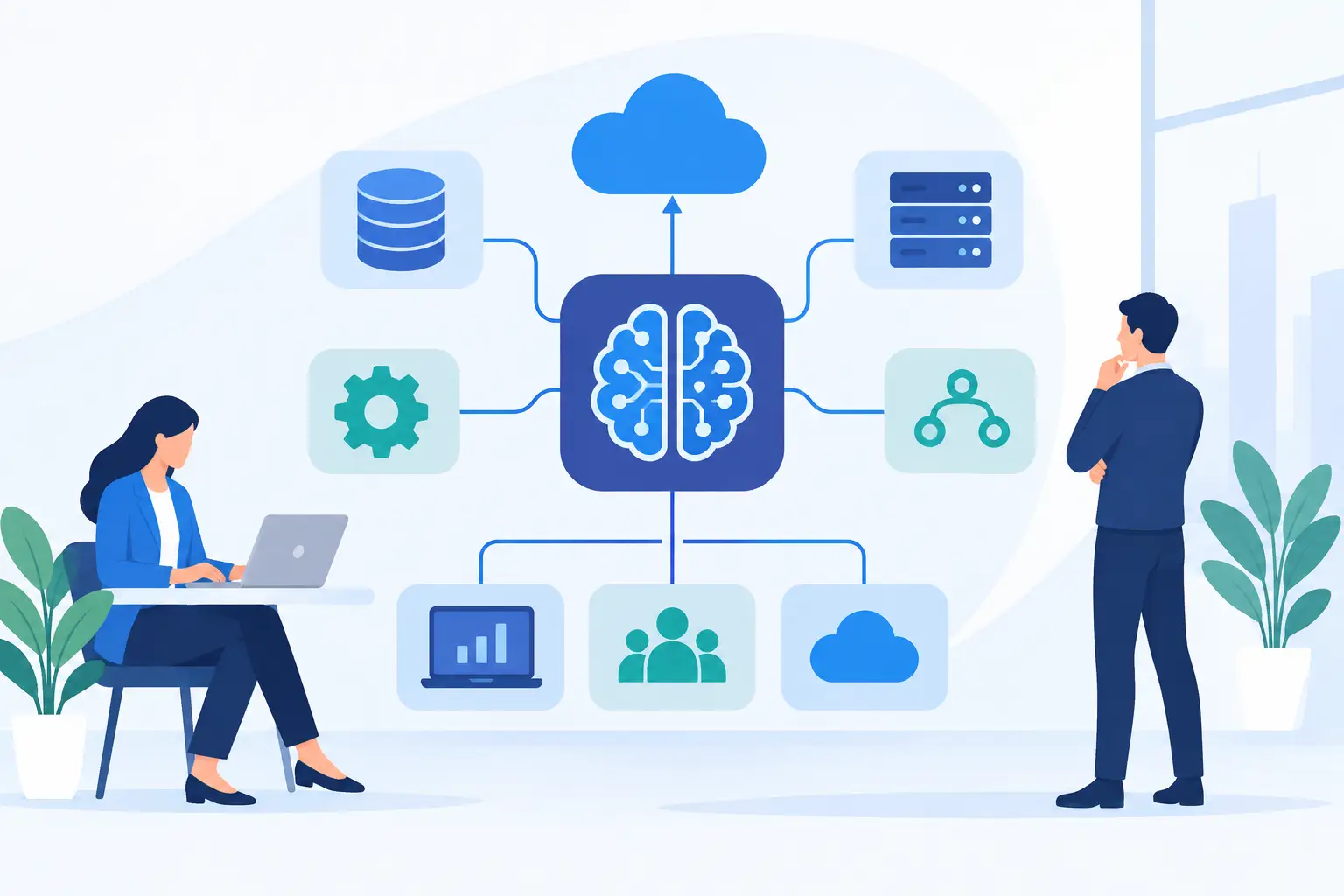
A production architecture does not need to be unnecessarily complex. It does need clear boundaries. The following six layers are the minimum for AI systems that will touch real operations.
1. Knowledge and retrieval
An agent needs access to authoritative business knowledge: policies, contracts, procedures, product information, case records, and other documents relevant to its role. That knowledge should be ingested with metadata that preserves source, owner, document type, date, business unit, and sensitivity.
Retrieval is not just a search problem. It is an access-control problem. A policy document available to the whole company is different from a compensation plan, a medical record, or a client matter file. The system must filter what the agent can retrieve before the model generates an answer.
Every material answer should show its source. If an employee cannot inspect the relevant contract clause, procedure, or system record, they cannot verify the response. Source-backed answers make agents more useful because users can challenge them productively rather than guessing whether the output is credible.
2. Identity and permissions
Every agent needs a named identity and a defined permission limit. “Operations assistant” is not a permission model. It is a label.
The agent should inherit or map to the requesting user's access rights where appropriate. In other cases, it may operate through a dedicated service identity with narrowly scoped access. Either way, the system needs an explicit answer to three questions: who is making the request, what data may they see, and what actions may the agent perform on their behalf?
This matters most when agents cross system boundaries. An assistant that reads a CRM record, checks an ERP status, and drafts an email should not automatically have authority to change a payment term or send a customer commitment. Read access, draft access, and write access are different capabilities. Treat them that way.
3. Tool integrations and action controls
Useful agents do more than answer questions. They retrieve live data, create tickets, prepare documents, update fields, and trigger workflow steps. Those actions should be exposed through tested tools or APIs, not improvised browser automation where a stable integration exists.
Keep tools narrow. “Update customer record” is better than unrestricted database access. “Create a draft work order” is better than “manage maintenance operations.” Narrow tools reduce the blast radius of an incorrect instruction, prompt injection, or application defect.
For consequential actions, introduce approval gates. The agent can prepare the proposed email, transaction, work order, or record update. A named human approves it. This is not a temporary compromise while the technology matures. In many regulated, financial, legal, and safety-sensitive workflows, human approval is the correct permanent design.
4. Orchestration and workflow state
A chat window has limited memory and poor process control. Enterprise work often has stages, deadlines, exceptions, attachments, owners, and status changes. The architecture needs a workflow layer that knows what has happened, what must happen next, and when the agent should stop.
For example, a claims agent may collect documents, extract fields, compare them against policy conditions, flag missing evidence, and prepare a recommendation. It should not quietly convert that recommendation into a final decision. The workflow state should show which step is complete, what evidence was used, and who owns the next action.
This is where many agent projects become fragile. Teams ask a model to manage a multi-step process through prompts alone. That can work in a prototype. It is unreliable when the process has commercial consequences.
5. Evaluation and observability
You cannot govern an AI system you do not measure. Before deployment, build a test set from real, representative cases. Include straightforward requests, ambiguous requests, outdated documents, missing data, conflicting sources, restricted records, and attempts to make the agent exceed its authority.
Evaluate more than whether the wording sounds good. Test source accuracy, citation quality, permission compliance, tool selection, action correctness, escalation behavior, latency, and cost. A fluent answer with the wrong source is a failure. An agent that correctly refuses an unauthorized request is a success.
Production monitoring should capture the same signals over time. Models change. Source systems change. A business process changes after a policy update or acquisition. Evaluation is not a launch checklist. It is an operating discipline.
6. Ownership, security, and change management
An architecture diagram is incomplete until each component has an owner. Someone must own the data source, the integration, the workflow, the evaluation suite, and the business outcome. If ownership is shared by everyone, it is owned by no one.
Security review should address data residency, retention, vendor terms, access logging, secrets management, and incident response. The correct level of control depends on the sector and data involved. A public knowledge assistant and an agent handling health, financial, or legal information should not have the same design or approval path.
The same is true of rollout. Launching to a small, accountable group gives you better feedback than announcing an enterprise-wide chatbot nobody trusts. Start with a high-value workflow, instrument it, fix the failure modes, and expand only when the system earns broader access.
Build a Shared Foundation, Not a Collection of Bots
The expensive part of enterprise AI is usually not creating the first interface. It is repeatedly solving the same foundations: document access, authentication, source attribution, tool connections, audit logs, evaluation, and approvals.
When every department buys or builds its own point solution, those controls get recreated inconsistently. Sales has one assistant. Operations has another. Legal blocks a third. Data is copied into separate systems, permissions drift, and nobody can explain the overall risk posture.
A shared infrastructure layer changes the economics. Once knowledge connectors, identity rules, evaluation methods, and action controls are in place, each additional agent becomes narrower and faster to deliver. The organization can still use different models or interfaces where it makes sense. The governance and operating standards stay consistent.
This does not mean centralizing every decision in an AI committee. It means centralizing the parts that should not vary: permission enforcement, auditability, secrets handling, evaluation criteria, and engineering patterns. Business teams should own the workflow requirements. The platform should make safe delivery repeatable.
Common Architecture Mistakes
The first mistake is treating a general-purpose chat product as enterprise architecture. It may be useful for individual productivity. It is not automatically connected to your systems, aware of your rules, or accountable for an operational result.
The second is giving an agent broad access because integration is inconvenient. This creates a security and quality problem at the same time. An agent with unrestricted data access retrieves more irrelevant material, exposes more sensitive information, and becomes harder to audit.
The third is automating final decisions too early. Use AI to gather, classify, draft, summarize, and recommend before asking it to commit a financial, legal, personnel, or customer-facing action. Full automation may be justified later. It should be earned through evidence, not assumed from a promising demo.
The fourth is measuring adoption instead of outcomes. A thousand prompts do not prove value. Track the operational measure tied to the workflow: turnaround time, rework rate, case resolution, margin protection, conversion, compliance exceptions, or hours returned to skilled staff.
A Practical Delivery Sequence
Begin with a short discovery period grounded in real work. Map the workflow, source systems, decision rights, exception paths, and success measure. Select one production agent with a bounded job and a credible economic case.
Then build the shared components required for that agent, not an oversized platform designed for hypothetical future needs. Connect authoritative data sources, establish identity and permissions, define tools, create evaluations, and assign an internal owner. Deploy to a controlled user group with clear feedback channels and approval rules.
After the first agent is producing measurable value, reuse the foundation for the next workflow. That is the point where AI adoption starts becoming an operating capability rather than a sequence of pilots. Firms such as TwoHundred.ai build this foundation inside the client's existing codebase and systems so the organization retains control after delivery.
The right next step is not a broad AI roadmap. Pick one workflow where delay, inconsistency, or manual effort is visible. Define what the agent may know, what it may do, what it must cite, and who approves the result. If those answers are clear, you have a buildable system. If they are not, buying another AI tool will not fix the problem.
Related implementation paths
AI implementation services
Turn the article into a scoped first system with clear ownership, data, and measurement.
AI agent development company
Design agents around jobs, tools, approval points, and measurable business outcomes.
AI workflow automation
Automate one operational workflow inside the tools the team already uses.
Imraan, Founder of twohundred
Working through one of these decisions?
Book a 30-minute call. We will look at the specific workflow you are trying to put AI into, and what it would actually take to make it work in production.
Book a call