AI Workflow Automation Consulting That Ships
Direct answer
AI workflow automation consulting builds controlled, source-backed production systems from fragmented tools, data, and high-value human workflows safely.
Most AI programs fail before the model makes its first mistake. They fail because the company buys a tool before defining the workflow, gives it broad access before setting permissions, and calls a demo a deployment. AI workflow automation consulting should correct that sequence. The job is not to add another chatbot. It is to make a specific business process faster, safer, and easier to operate.
For established businesses, the hard part is rarely generating text. The hard part is connecting AI to the systems where work actually happens: a CRM with inconsistent records, a document repository full of contracts, an ERP, an inbox, a legacy line-of-business application, and a set of approval rules that exist mostly in experienced employees' heads.
That is why generic training and isolated pilots produce so little value. They may improve individual productivity. They do not create a controlled operating capability.
What AI workflow automation consulting should deliver
A credible engagement starts with an operational problem, not a preferred model or a list of fashionable use cases. Consider a claims team that spends hours reading attachments, checking policy language, gathering missing information, and preparing a recommendation for review. The opportunity is not "build a claims chatbot." It is to reduce handling time while preserving the controls required for a decision that affects customers and risk.
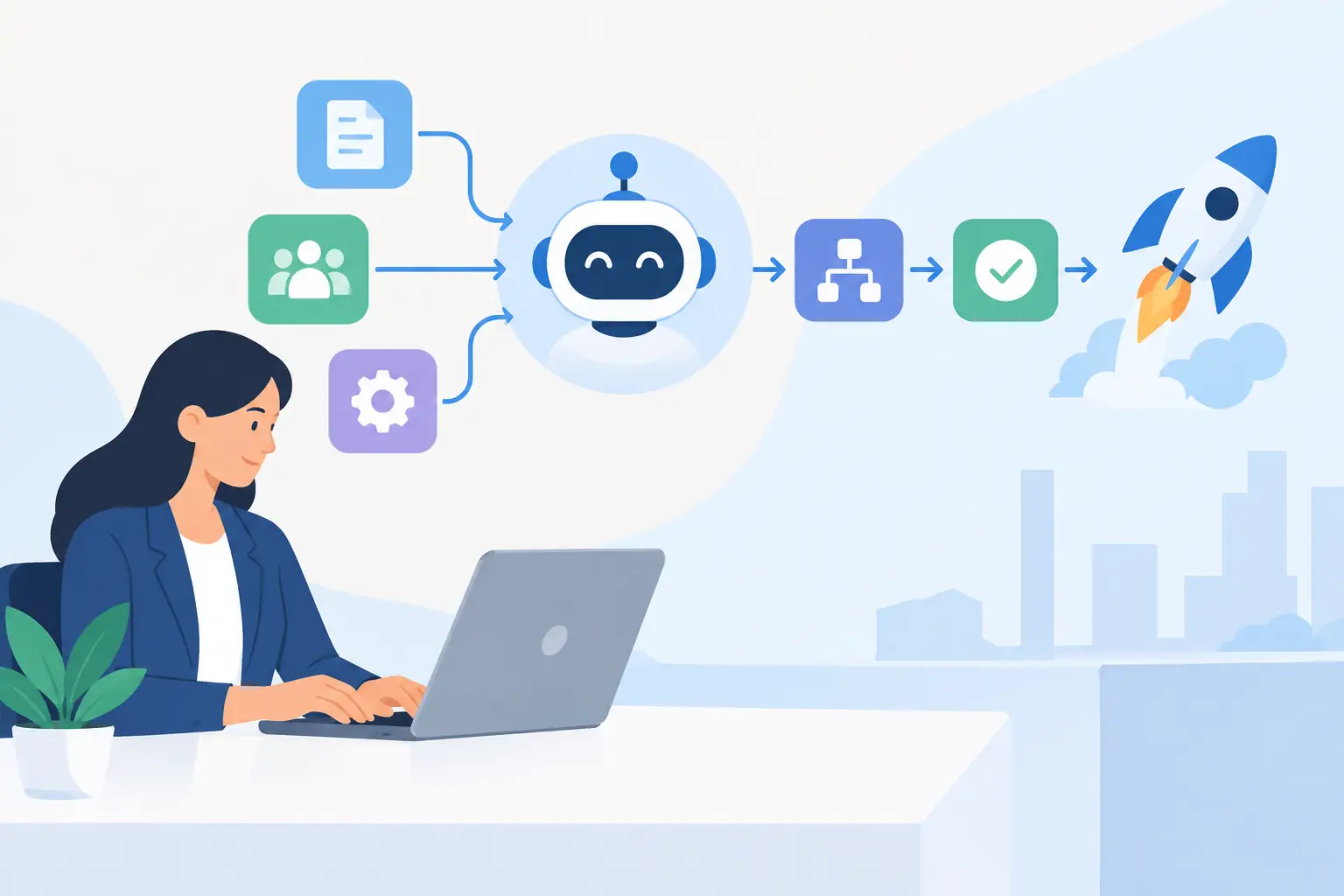
The resulting system may classify incoming documents, extract specific fields, retrieve the relevant policy clauses, identify missing evidence, draft a case summary, and route the case to the correct reviewer. Each action needs clear boundaries. The agent should know which records it may access, which tools it may call, when it must ask for approval, and what it should do when the available evidence is insufficient.
Good consulting produces working software around that process. It defines the workflow, builds the integrations, establishes the controls, tests failure modes, deploys the system, and assigns an internal owner. A slide deck can support this work. It cannot substitute for it.
The shared foundation matters more than the first agent
Companies often start with a single assistant for sales, operations, or customer service. That can be sensible, but only if the first agent is built on infrastructure that can be reused. Otherwise, the second and third agents repeat the same expensive work: reconnecting data sources, recreating permissions, rebuilding prompt logic, and rediscovering what happens when the model is wrong.
A useful AI foundation brings together company knowledge, tool integrations, identity, permissions, source attribution, evaluation data, and approval controls. It gives every agent a named identity and a defined scope. It also creates a consistent way to observe what the agent did, what it used as evidence, and where a human intervened.
This is not architecture for architecture's sake. It changes the economics of delivery. Once a company can safely retrieve approved knowledge, call approved systems, and log decisions against a shared control layer, new workflows move faster. The first deployment has to carry the cost of the foundation. Subsequent deployments should not.
There is a trade-off. A small, low-risk internal task may not justify a broad platform effort. If a team only needs to summarize meeting notes from a single source, a lightweight implementation may be enough. But when the workflow touches customer records, regulated information, commercial decisions, or several business systems, shortcuts become operational debt quickly.
Start where work is expensive and measurable
The best candidates for automation are not necessarily the most visible. They are workflows with a high volume of repetitive judgment, fragmented information, clear handoffs, and a measurable cost of delay or error.
Examples include preparing client onboarding packs, triaging service requests, checking construction submittals against project requirements, drafting recruitment shortlists, assembling property due-diligence files, reconciling logistics exceptions, or producing first-pass responses to recurring customer questions. In each case, the goal is not to remove all human judgment. It is to remove the time spent locating information, applying routine checks, and producing a usable first draft.
The first discovery phase should establish a baseline. How many cases are processed each week? How long does each case take? Where do people wait? What errors are costly? Which decisions require a licensed, accountable, or senior employee? Without these answers, projected ROI is usually theater.
A practical scope names one or two production agents and defines the outcome in business terms. For example: reduce the time to prepare a compliant client file from 90 minutes to 25, while requiring human approval before any external communication. That is a testable target. "Transform operations with AI" is not.
Build controls into the workflow, not around it
An AI agent that can answer questions is easy to demonstrate. An agent that can act safely inside a live workflow requires more discipline.
Source-backed output is one requirement. If an agent summarizes a contract, recommends a policy action, or prepares a customer response, users should be able to see the documents and records behind its conclusion. This makes review faster and exposes weak source material before it reaches a customer.
Permissions are another requirement. An agent should receive the minimum access needed for its task, not a company-wide view of every file and system. A service agent may read an account's current case history but should not be able to access unrelated financial records. A drafting agent may prepare a message but should not send it without approval.
Evaluation is the requirement many teams skip. Before deployment, test the agent against representative cases, difficult cases, incomplete records, conflicting sources, and adversarial instructions hidden in documents. Track whether it retrieved the right evidence, followed the workflow, respected permissions, and escalated correctly. Model quality is only one part of system quality.
Human approval should be designed with equal care. Requiring approval for every minor action destroys the benefit of automation. Removing approval from a high-consequence action creates unnecessary exposure. The right threshold depends on the process, error tolerance, and the organization’s ability to audit outcomes.
How AI workflow automation consulting becomes a delivery model
The consulting model matters because AI work changes as soon as real users touch it. A fixed, one-time project often encourages teams to optimize for a launch date rather than operational performance. An open-ended advisory retainer creates the opposite problem: plenty of meetings, unclear output.
A better model is a rolling engagement tied to named production agents and measurable delivery milestones. Early work maps the process and designs the shared foundation. Engineering then embeds with the client team to build within the existing codebase and business tools where appropriate. Users test the workflow with real cases. The team fixes failures, deploys with controls, and documents the system for handover.
This approach also forces commercial honesty. Some opportunities should not be automated yet. If the underlying process has no defined owner, the source data is unusable, or transaction volume is too low to justify engineering effort, the right recommendation may be to fix the process first. A consultancy that cannot say this is selling activity, not value.
TwoHundred.ai works this way because the client should retain the capability after the engagement. The code, documentation, evaluation approach, and operating knowledge should remain with the internal team. Dependency is not a delivery outcome.
Questions buyers should ask before committing
Ask what will be in production, who owns it internally, and how success will be measured. Ask which systems the agent will read from and write to. Ask how identity and permissions are enforced. Ask whether outputs show their sources. Ask how incorrect behavior is tested before customers see it. Ask where human approval is required and how exceptions are handled.
Also ask what happens after the first agent. If every new use case requires a fresh integration layer, a new permission model, and a new way to evaluate quality, the provider is building isolated applications. That may solve one local problem. It will not create an AI-native organization.
The useful next step is not a broad AI strategy session. Choose one workflow where delay, manual effort, or error has a visible cost. Put an accountable owner beside the engineers. Define the controls before the interface. Then build something your team can operate long after the first demo is forgotten.
Related implementation paths
AI implementation services
Turn the article into a scoped first system with clear ownership, data, and measurement.
AI workflow automation
Automate one operational workflow inside the tools the team already uses.
AI agent development company
Design agents around jobs, tools, approval points, and measurable business outcomes.
Imraan, Founder of twohundred
Working through one of these decisions?
Book a 30-minute call. We will look at the specific workflow you are trying to put AI into, and what it would actually take to make it work in production.
Book a call