AI Reconciliation Automation That Holds Up
Direct answer
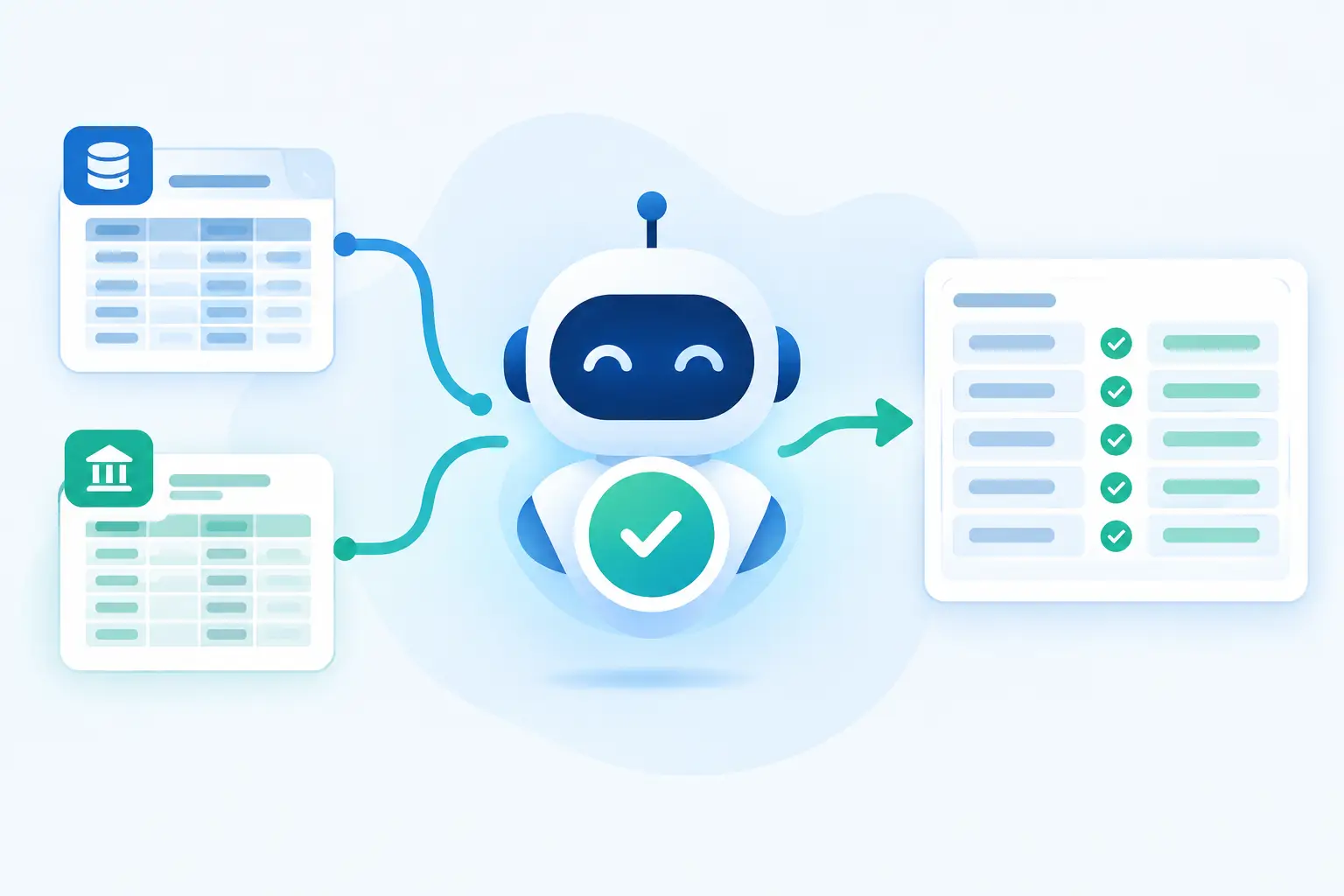
AI reconciliation automation reduces manual work when records, rules, approvals, and exceptions are governed with traceable audit evidence at real scale.
A reconciliation process rarely fails because people cannot match numbers. It fails because the business has too many systems, too many exceptions, and no reliable way to prove why a match was made. AI reconciliation automation can reduce the manual burden, but only if it is built around the controls finance and operations already depend on.
That distinction matters. A model that suggests matches inside a spreadsheet may look impressive in a demo. A production system must know which records it is allowed to access, which matching rules apply, when to request human approval, and how to leave an audit trail that survives scrutiny.
Why reconciliation is a better AI use case than it looks
Reconciliation sits at the point where operational reality meets financial reporting. A payment must match an invoice. A bank transaction must match an ERP entry. A carrier charge must align with a shipment and contractual rate. A property management payment must reconcile to a tenant ledger. The work is repetitive, but it is not simple.
Most teams already use deterministic rules for the easy cases: same invoice number, same amount, same date range. The remaining queue contains the expensive work. Partial payments, bundled remittances, duplicate references, missing identifiers, currency conversion, timing differences, credits, fees, and adjustments all require someone to interpret context across multiple systems.
This is where AI can help. It can read unstructured remittance advice, recognize patterns in historical resolution decisions, retrieve related documents, and propose likely matches with an explanation. It can also classify exceptions into useful queues rather than leaving analysts to work from a single undifferentiated backlog.
But “likely” is not the same as “correct.” In finance, an untraceable answer is not an answer. If an agent cannot cite the source transaction, the applicable rule, and the reasoning behind the recommendation, it has not reduced risk. It has relocated it.
AI reconciliation automation needs rules before models
The common mistake is starting with the model. Teams connect an LLM to transaction data, ask it to reconcile records, and discover that outputs vary, confidence scores are vague, and the approval process is unclear. They have created a new interface for ambiguity.
A better approach begins with process design. Define the record types, source systems, match states, approval thresholds, and exception categories. Establish which rules are deterministic and which decisions require judgment. Then use AI where it adds value: interpreting messy inputs, retrieving supporting evidence, ranking possible matches, and drafting a reason for review.
For example, an accounts receivable team might define four outcomes: auto-post, analyst review, customer query, and hold. A payment can only auto-post when the system has high-confidence evidence from approved sources and the match falls within configured tolerance. A partial payment or missing remittance reference may be routed to an analyst with the relevant invoice history, customer correspondence, and prior payment patterns already assembled.
This is not a technical detail. It is the operating model. Without it, the organization cannot tell whether automation is improving close speed or simply making errors harder to spot.
Deterministic matching still does most of the work
AI should not replace rules that already work. Exact identifiers, known payment references, approved tolerance bands, and clear date logic should remain deterministic. They are cheaper to run, easier to test, and easier to explain.
AI earns its place in the unresolved portion of the queue. It can extract fields from documents that do not follow a standard format. It can identify that several payments likely belong to one invoice group. It can compare a free-text description against contract terms or prior reconciliations. It can propose a match where a human would otherwise search across six systems.
The practical result is a hybrid workflow. Rules clear the obvious transactions. AI investigates ambiguity. People authorize consequential decisions.
The architecture behind reliable reconciliation automation
A reconciliation agent should not have broad, uncontrolled access to company data. It needs a named identity, an explicit permission boundary, and source-specific access. A cash application agent may read bank feeds, open invoices, remittance documents, and customer account history. It should not automatically be able to change master data, release held payments, or access unrelated personnel records.
It also needs a shared foundation rather than a one-off connection to every tool. That foundation should manage identity, permissions, source retrieval, integrations, logging, evaluations, and human approval controls. Otherwise, each new workflow recreates the same security and governance problems.
The system should retain the evidence used for every recommendation. An analyst reviewing a proposed match should see the bank transaction, the candidate invoices, the extracted remittance details, the matching rules applied, and the reason the system selected one outcome over another. A reviewer should not need to ask the agent to explain itself in a separate chat window.
Write actions require even tighter controls. An agent can prepare a journal entry, proposed payment allocation, or case update. Whether it posts that action automatically depends on risk, confidence, materiality, and the organization’s policy. In many environments, human approval is the correct design choice. Automating a click is not worth automating a bad decision.
Where teams get the economics wrong
The business case is not “reduce headcount.” Reconciliation automation is often valuable because it shortens close cycles, lowers the volume of aged exceptions, improves cash application speed, and gives experienced staff more time for investigation and customer resolution.
The highest-return workflows usually have three characteristics. They have substantial volume, fragmented supporting data, and a measurable cost of delay or error. Cash application, bank reconciliation, intercompany matching, freight invoice audit, claims reconciliation, and commission validation often qualify. A low-volume process with inconsistent source data may not.
That last point deserves more attention. Not every reconciliation process needs AI. If a team processes 200 clean records each month and a well-maintained rule engine clears nearly all of them, custom AI work may not justify the investment. A blunt answer early is cheaper than a polished pilot that never reaches production.
The right baseline is not a vendor’s claimed accuracy rate. Measure current throughput, exception volume, time to resolution, write-offs, rework, close delays, and error rates. Then measure the automation against those numbers by transaction type. If it cannot improve a meaningful operational metric, it is not a priority.
How to deploy AI reconciliation automation without creating a black box
Start with one named workflow and one accountable internal owner. Do not begin with “automate finance.” Begin with a narrow process such as matching incoming payments to open invoices for a defined business unit, currency, or customer segment.
Use historical cases to build an evaluation set before releasing anything. Include clean matches, known edge cases, previously corrected errors, and transactions that should remain unresolved. Test not only whether the agent identifies the right match, but whether it cites the right evidence, follows permission boundaries, selects the correct escalation path, and refuses to act when inputs are insufficient.
Run the system in recommendation mode first. Let it prepare matches beside the existing process and compare its decisions with analyst outcomes. This exposes data quality problems and policy gaps that a prototype hides. It also establishes which confidence thresholds are meaningful for your organization, rather than accepting a generic score from a model.
Only then move selected categories into controlled automation. Keep monitoring outcomes. Reconciliation patterns change when customers change payment behavior, ERP fields are altered, banks modify reference formats, or a new acquisition adds another ledger. Production systems need evaluations after launch, not just before it.
TwoHundred.ai approaches this as an engineering problem: build the shared controls once, deploy a narrowly scoped agent, test it against real cases, and retain ownership inside the client team. That is slower than a chatbot demo in week one. It is faster than replacing a failed pilot six months later.
The test is whether finance can trust the exception queue
The strongest outcome is not a claim that reconciliation is fully autonomous. It is an exception queue that is smaller, better organized, and backed by evidence. Analysts should spend their time on the transactions that genuinely need judgment, with the relevant context ready for review.
If your team cannot explain why an automated match happened, who approved it, and what source records support it, the process is not ready for scale. Build those answers into the workflow first. Then let AI handle the work that is actually holding people back.
Related implementation paths
AI workflow automation
Automate one operational workflow inside the tools the team already uses.
AI implementation services
Turn the article into a scoped first system with clear ownership, data, and measurement.
AI agent development company
Design agents around jobs, tools, approval points, and measurable business outcomes.
Imraan, Founder of twohundred
Working through one of these decisions?
Book a 30-minute call. We will look at the specific workflow you are trying to put AI into, and what it would actually take to make it work in production.
Book a call