AI Legacy System Integration That Actually Works
Direct answer
AI legacy system integration connects real workflows, data, permissions, and approvals so useful agents reach production without breaking control at scale.
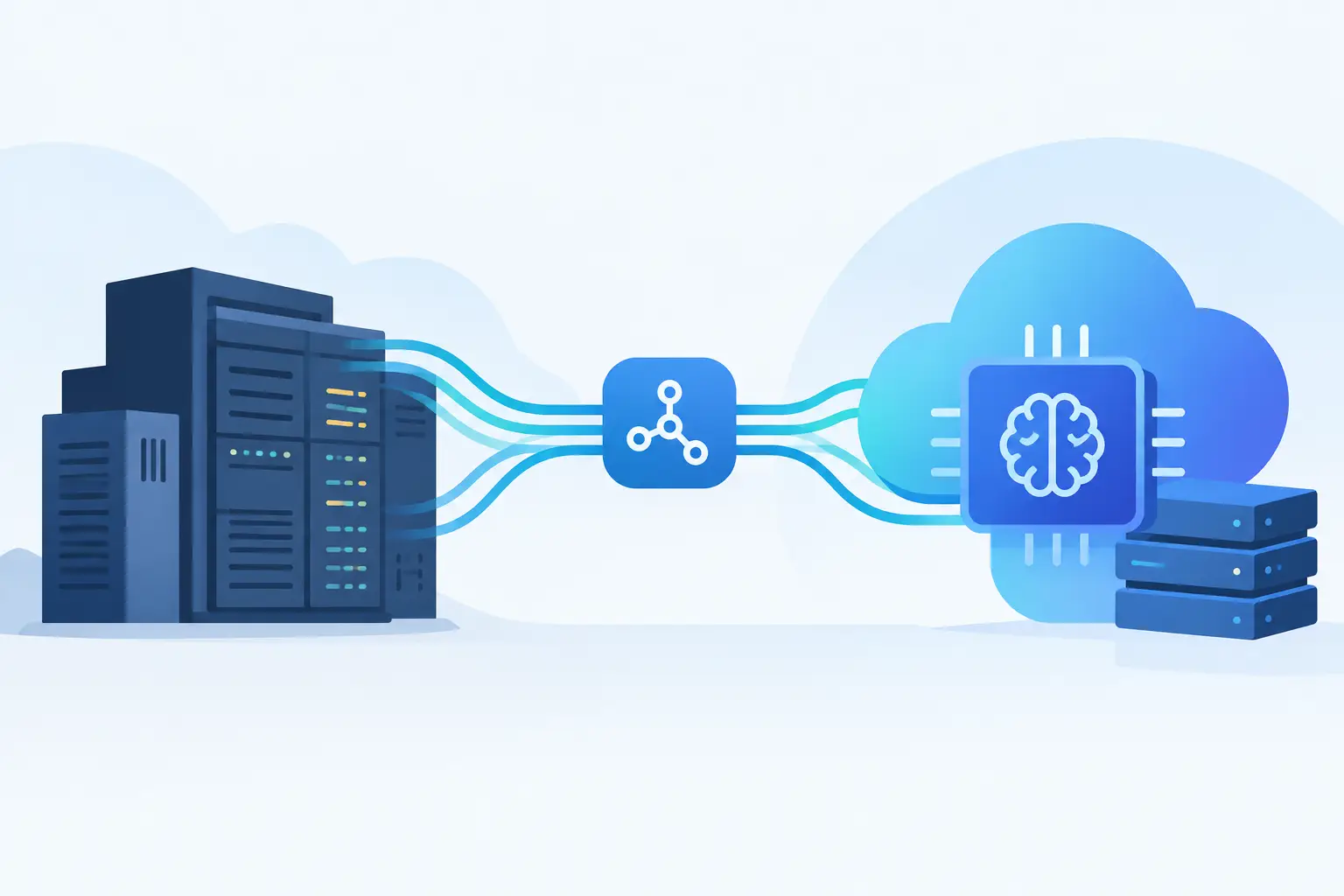
Most AI initiatives fail at the point where a model has to interact with the business. AI legacy system integration is not about placing a chat interface over an old database. It is about making AI useful inside the systems that hold customer records, contracts, job data, policies, approvals, and operational history - without giving it access it has not earned.
That distinction matters. A generic assistant can summarize a document in minutes. A production agent that can answer a client question using the right version of a policy, respect regional access rules, cite its sources, and hand off an exception to a named employee is a different engineering problem.
Established businesses do not need another isolated AI pilot. They need AI that works within the operational reality they already have.
Why AI legacy system integration usually stalls
Legacy systems are rarely the real problem. They are often the record of how the business actually operates. An ERP may contain years of order and inventory history. A CRM may define account ownership. A document platform may hold signed agreements. A homegrown workflow tool may encode the approval path nobody documented elsewhere.
The problem starts when teams treat those systems as data buckets instead of business controls. They connect a model to everything, hope retrieval will produce useful answers, then discover the agent cannot distinguish between a draft and an approved document, a current customer record and an archived one, or a user who should see pricing and one who should not.
This creates predictable failure modes. The agent gives confident answers from stale material. It exposes information across teams or clients. It recommends an action but cannot complete it because the underlying workflow has no safe handoff. Or it becomes another tab employees ignore because it has no place in the work they already do.
The answer is not more prompt writing. It is architecture.
Start with a workflow, not a model
A useful integration begins with a narrowly defined operational decision or task. “Build an AI assistant for the business” is not a scope. “Help claims handlers identify missing evidence before a file moves to review” is a scope. So is “prepare a sourced response to a client’s contract question for legal approval.”
The workflow should have an owner, a user group, a measurable baseline, and a clear boundary. If nobody can explain what happens before and after the agent acts, the work is not ready for production.
This also prevents a common waste pattern: buying a broad AI platform before deciding what it must do. A platform may be part of the answer, but it does not replace the work of mapping systems, permissions, exceptions, and human decisions.
For each proposed agent, establish four things early: the source systems it can read, the tools it can use, the people it serves, and the actions it is allowed to take. These choices define the agent more clearly than its model provider does.
Build a shared control layer before multiplying agents
The first production agent should not require a new integration pattern, security model, or knowledge store every time. That is how companies accumulate disconnected tools that each need separate maintenance, separate access reviews, and separate explanations when something goes wrong.
A better approach is a shared AI foundation that sits across existing systems. It should connect company knowledge and operational tools while retaining the organization’s identity model and permissions. When a user asks a question, the system must determine who they are, what they can access, which sources are authoritative, and whether an answer requires approval before it can be used externally.
This foundation does not need to replace the ERP, CRM, document management platform, or internal application. In many cases, replacing those systems is unnecessary and commercially reckless. The foundation should make their information and approved actions available through controlled interfaces.
A practical shared layer includes source-aware retrieval, identity and permission enforcement, tool connectors, audit logs, evaluation data, and approval controls. Each component exists for a reason.
Source-aware retrieval lets an agent point to the document, record, or policy behind an answer. Identity and permissions stop a helpful agent from becoming an access-control failure. Tool connectors allow an agent to create a draft, open a case, or update a record only when the workflow permits it. Evaluations show whether the agent remains accurate as systems, documents, and business rules change.
Without these controls, each new agent is a fresh technical and governance project. With them, the second and third agents are faster to deploy because the hard parts are already in place.
Treat data quality as an operating decision
Not every document should be available to an AI agent. Not every data field should be indexed. And not every source deserves equal weight.
A contract repository may contain signed agreements, templates, negotiation notes, and obsolete versions. An agent answering customer-facing questions should not treat all four as interchangeable. It needs a documented source hierarchy and rules for what to do when authoritative information is absent or conflicts.
This is where many teams overpromise. They say the agent can “search all company knowledge,” then quietly accept that much of that knowledge is duplicated, unstructured, outdated, or unowned. AI can help identify gaps and classify material, but it cannot invent governance that the business has avoided.
The commercially sensible approach is to begin with the sources that drive a high-value workflow. Clean and connect those first. Expand when the agent is demonstrably useful. A smaller, trusted knowledge scope is worth more than a sprawling system that produces plausible but unverifiable answers.
Give every agent a defined authority
An AI agent should have a named identity and a permission limit. That means it should be possible to answer simple questions: What is this agent for? Which systems can it access? What actions can it take? Who owns it? When must it ask for approval?
The level of autonomy depends on the risk of the task. An internal research agent may only need read access and source citations. A proposal-drafting agent may create a draft in a CRM but require a manager to approve the final version. An agent that changes payment terms, sends external notices, or updates regulated records should operate under far tighter controls, if it is allowed to act at all.
Human approval is not a sign that the implementation failed. In high-stakes work, it is often the correct design. The goal is not to remove judgment from a process. It is to remove unnecessary searching, copying, checking, and administrative delay while preserving accountable decisions.
Test the bad outcomes before users find them
A demo proves that an agent can produce an impressive answer once. It does not prove that it can operate safely next month with a different user, a revised policy, or incomplete data.
Production AI needs evaluations built around the work it performs. For a knowledge agent, test whether answers are grounded in approved sources, whether citations are correct, and whether it declines to answer when evidence is missing. For a workflow agent, test tool permissions, handoffs, duplicate actions, failed integrations, and recovery paths.
The test set should include normal requests, ambiguous requests, prohibited requests, outdated information, conflicting sources, and attempts to access restricted data. Incorrect outputs should be found before customers or frontline teams see them.
This work is not glamorous, but it is where trust is earned. If a vendor cannot describe how the agent is evaluated, who reviews failures, and how changes are released, they are selling a prototype, not an operating capability.
Deploy where the work already happens
Adoption improves when the agent appears in the environment people already use. That may be a service desk, CRM, internal portal, document workflow, or customer application. Forcing employees into a separate AI destination usually creates one more place to forget to check.
There is a trade-off. Embedding AI in a core system can require more engineering than launching a standalone chat tool. But the value is usually higher because the agent receives relevant context, can follow the existing workflow, and creates an auditable result where the business expects to find it.
Measure the outcome in operational terms. Track time to resolution, rework rate, approval turnaround, first-response quality, conversion, exceptions caught, or revenue protected. Usage alone is a weak metric. People can use a tool frequently and still receive no commercial value from it.
Scale only after ownership is real
The best time to plan the second agent is after the first one has a working owner, known evaluation process, and documented integration pattern. At that point, the organization has learned what its data can support, where approvals belong, and which controls are reusable.
That is the difference between a collection of AI experiments and an AI-native operating capability. The business retains the code, the integrations, the evaluation logic, and the knowledge of how the system works. It is not dependent on a vendor’s black box or a consultant’s slide deck.
TwoHundred.ai approaches this work by embedding engineers into the client team and building the shared foundation alongside named production agents. The engagement should remain tied to working systems, not a vague transformation promise.
The next useful AI investment is rarely the flashiest one. It is the workflow where reliable access to the right information, the right tools, and the right human approval removes friction that the business already pays for every day.
Related implementation paths
AI implementation services
Turn the article into a scoped first system with clear ownership, data, and measurement.
AI workflow automation
Automate one operational workflow inside the tools the team already uses.
AI agent development company
Design agents around jobs, tools, approval points, and measurable business outcomes.
Imraan, Founder of twohundred
Working through one of these decisions?
Book a 30-minute call. We will look at the specific workflow you are trying to put AI into, and what it would actually take to make it work in production.
Book a call