AI Intake Automation That Doesn't Lose Control
Direct answer
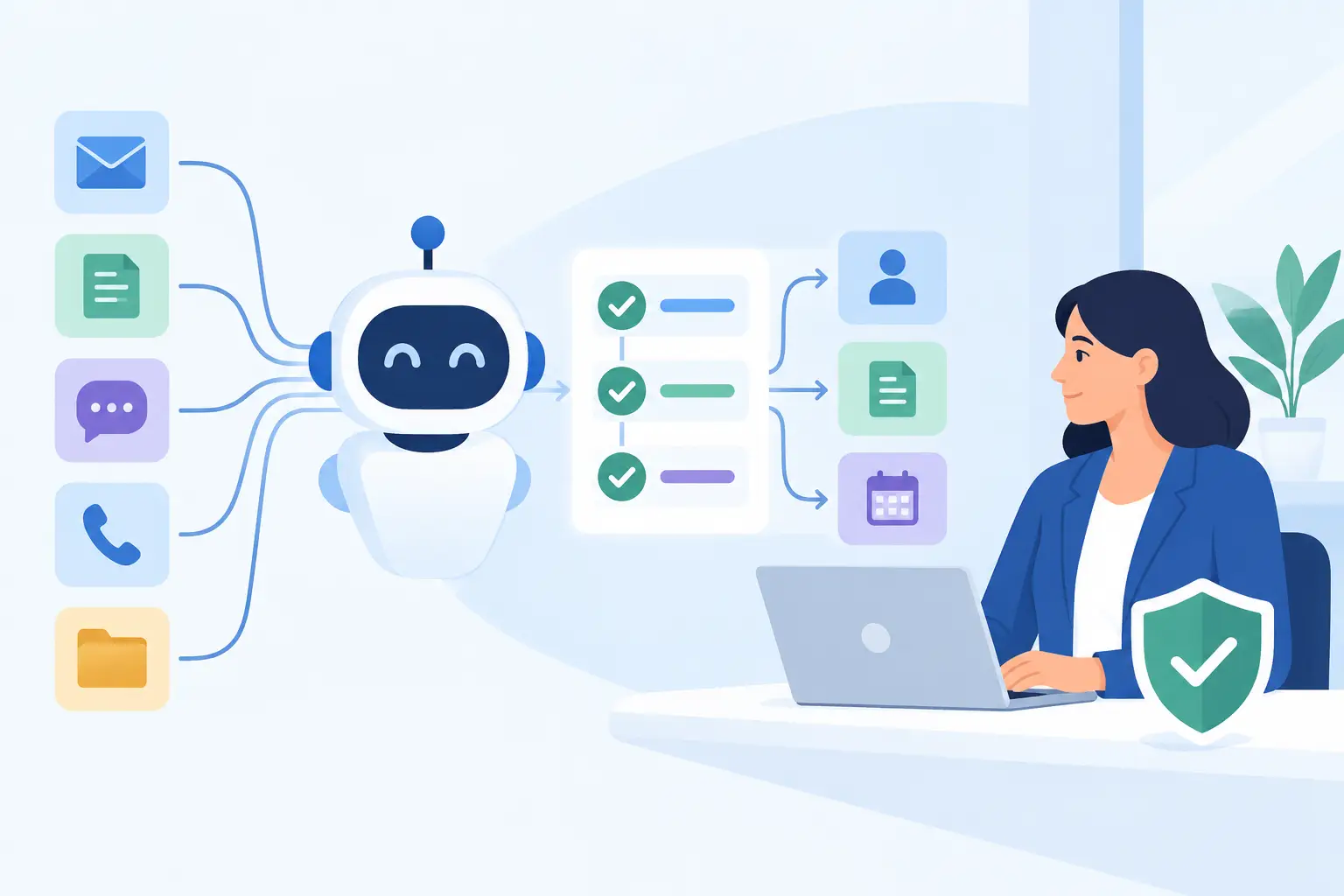
AI intake automation routes requests, checks documents, protects permissions, and sends exceptions to accountable people before work stalls or risk grows.
A request arrives in an inbox with an incomplete form, three attachments, and a vague subject line: "Need approval ASAP." Someone must decide what it is, find the relevant account history, check whether the requester is authorized, and send it to the right person. That is where AI intake automation earns its keep. Not by replacing judgment, but by removing the manual sorting work that prevents judgment from happening quickly.
Most businesses already have intake processes. They live across shared inboxes, web forms, ticketing tools, call notes, PDFs, spreadsheets, and the heads of experienced staff. The problem is not a lack of software. The problem is that the operating logic is fragmented, undocumented, and dependent on people remembering what to do next.
AI Intake Automation Is a Control Problem
The usual pitch is faster triage. Faster triage matters, but it is not the real requirement in regulated, operationally complex, or customer-critical work. A fast system that classifies a legal request incorrectly, exposes a restricted record, or silently drops an exception has made the process worse.
A production intake system needs to answer four questions every time: What is this request? Who is making it? What information supports it? What must happen next? If it cannot answer with enough confidence, it should route the case to a named human owner. That is not a failure of automation. It is a control.
This distinction separates useful AI intake automation from a generic chatbot bolted onto a form. A chatbot can collect text. An intake system needs to interpret unstructured information, apply business rules, retrieve evidence from approved sources, write structured records, and create a traceable handoff. It operates inside a workflow, not beside one.
What a Production Intake Agent Actually Does
An intake agent begins by gathering inputs from the channels your business already uses. That may mean an email mailbox, client portal, CRM, document repository, call transcript, or field-service application. It extracts the relevant facts, identifies missing information, and normalizes the request into a defined case structure.
For a property management business, that could mean distinguishing a maintenance request from an access issue, extracting the unit number and urgency, checking the lease or service agreement, and assigning the task to the correct regional team. For an insurance operation, it may mean recognizing a claim notification, identifying missing evidence, checking policy status, and escalating potential fraud indicators rather than making a coverage decision.
The valuable work happens after extraction. The agent checks the request against the systems that hold the source of truth. It applies permissions before it retrieves data. It records why it chose a route. It asks a follow-up question where the process requires one. It creates or updates the downstream record only when the evidence and confidence threshold justify that action.
Classify the work, not just the words
Classification should reflect the operational categories that determine handling, priority, service level, and risk. "Please help with my invoice" is not sufficient. Is the customer disputing a charge, requesting a copy, reporting a payment failure, or asking for a credit? Each path has different owners and permitted actions.
This is why a good intake build starts with real historical requests and their outcomes. Teams should examine what experienced operators actually do, including the exceptions they resolve without ever writing down the rule. A model can recognize patterns in language. It cannot invent a sensible operating policy for a business that has not defined one.
Extract facts with evidence attached
A useful intake record contains structured fields, not just a generated summary. It should capture the customer or case identifier, request type, relevant dates, requested action, urgency markers, missing documents, and confidence level. Where facts come from a document or knowledge source, the system should retain the source reference used to support them.
Source-backed extraction matters when a customer challenges an outcome or an internal reviewer needs to understand how the case was handled. "The AI said so" is not an explanation. A page reference, case note, signed agreement, or system record is.
Route exceptions deliberately
Not every request should be automated to completion. Cases involving uncertain identity, missing authority, conflicting records, unusual financial value, safety concerns, or legal commitments need a human route. The agent should state what it found, what it could not verify, and why it stopped.
That handoff needs an owner and a service target. Sending an ambiguous case to a generic queue simply moves the bottleneck. A well-designed system routes it to the team that can act and provides enough context that they do not need to repeat the intake from scratch.
Write back only within a defined permission boundary
Reading information and changing information are different risk levels. An intake agent may be allowed to create a draft ticket, tag a CRM record, or request missing documents. It should not be able to approve a payment, change contract terms, or disclose sensitive data unless the process explicitly permits it and the required approval is present.
Every agent needs a named identity, explicit tool permissions, and a limited action scope. This is basic engineering discipline. Without it, automation becomes a collection of invisible system changes that no one can explain after the fact.
The Architecture Determines Whether It Scales
A single intake workflow can be built quickly. The real test comes when the business wants similar automation for onboarding, claims, service requests, vendor documents, compliance reviews, and sales qualification. If each use case has its own prompts, disconnected data copy, and improvised access model, every new agent becomes expensive to maintain.
The better approach is to build a shared foundation first: governed access to company knowledge, integrations to operational systems, identity and permissions, source attribution, evaluation data, and approval controls. Then each intake agent uses that foundation while serving a clearly defined workflow.
This does not mean pausing for a six-month architecture program. It means building the common controls alongside the first high-value agent. TwoHundred.ai typically scopes this work around named production agents because a vague mandate to "automate intake" produces vague outcomes. A named agent has a known user, input channel, decision boundary, system access, and accountable internal owner.
Human Review Should Be Designed, Not Added Later
Many teams treat human review as a temporary safety net. In complex operations, it is often a permanent and valuable part of the process. The question is not whether people stay involved. The question is whether they spend their time on judgment rather than copying information between systems.
Set confidence thresholds based on the cost of being wrong. A low-risk request for a document copy may be handled automatically when the requester is verified. A request to change banking details should demand stronger verification and human approval even when the model appears confident. High confidence is not the same as authorization.
Evaluation is equally important. Before deployment, test the agent against real examples, including incomplete requests, conflicting documents, unusual language, duplicate submissions, and malicious instructions embedded in attachments. After deployment, review a sample of completed cases and every high-risk exception. Incorrect outputs should be found in testing, not by customers.
When AI Intake Automation Is the Wrong First Project
Not every intake process deserves an AI agent. If request volume is low, categories are already clear, or the underlying workflow has no agreed owner, automation may not justify the investment. A simple form redesign or clearer routing rule may solve the problem more cheaply.
It is also a poor first move when core records are unavailable, access rules are unresolved, or downstream teams cannot act on the outputs. AI can interpret messy inputs. It cannot compensate for a process with no service definition, no decision rights, and no reliable destination for work.
The strongest candidates have meaningful volume, costly manual review, repeatable categories, usable source data, and a measurable consequence of delay or error. Think of intake as a commercial process, not an AI demonstration. The target may be reduced response time, fewer abandoned cases, higher conversion, lower handling cost, better compliance evidence, or a combination of these.
Start With One Measurable Workflow
Choose a narrow intake process where the operational pain is visible. Document the current path from incoming request to completed action, including the systems touched, decisions made, failure points, and people who own exceptions. Then define the first production boundary.
Before release, agree on the operating standards:
- the request types the agent may handle
- the sources it may read and the actions it may take
- the conditions that force escalation to a human
- the metrics used to judge accuracy, speed, and business value
This approach may feel less exciting than announcing an enterprise AI program. It is also how you avoid buying another disconnected tool that creates more work than it removes. Build the first agent where the business can measure the result, retain ownership of the system, and reuse the controls for the next workflow.
The useful question is not whether AI can read your inbound requests. It can. Ask whether your business can prove what happened to each request, why it was routed that way, and who remains accountable when the answer matters.
Related implementation paths
AI workflow automation
Automate one operational workflow inside the tools the team already uses.
AI implementation services
Turn the article into a scoped first system with clear ownership, data, and measurement.
AI agent development company
Design agents around jobs, tools, approval points, and measurable business outcomes.
Imraan, Founder of twohundred
Working through one of these decisions?
Book a 30-minute call. We will look at the specific workflow you are trying to put AI into, and what it would actually take to make it work in production.
Book a call