AI Agents for Operations Need Controls, Not Demos
Direct answer
AI agents for operations create value when they work from approved data, respect permissions, escalate exceptions, and prove results in live workflows.
Most operations teams do not need another AI chat window. They need work to move faster without creating new failure points.
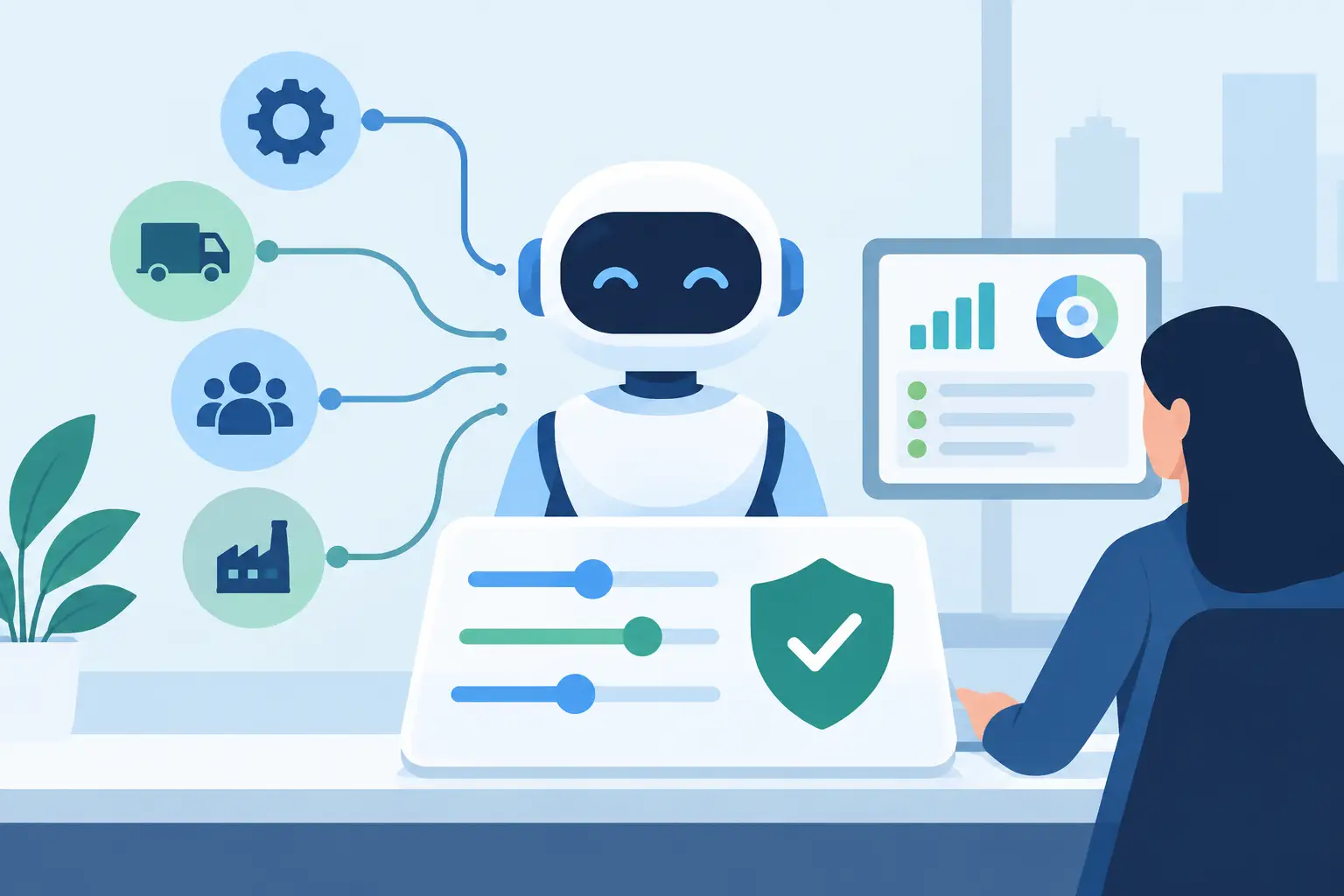
That is the test for AI agents for operations. Can the agent retrieve the right information, act only within its authority, show its sources, route exceptions to a person, and leave an auditable record? If the answer is no, it is a demonstration. It is not an operating capability.
The distinction matters because operational work is where vague AI claims meet real consequences. A missed renewal, an incorrect shipment instruction, an unsourced compliance answer, or a customer update sent to the wrong account is not a harmless hallucination. It is a service failure with a cost.
Why AI Agents for Operations Fail in Production
The common failure is not the model. It is the surrounding system.
A team starts with a useful-looking prompt. Someone connects it to a document folder or exports a spreadsheet. The agent can summarize, draft, and answer questions in a controlled demo. Then the business asks it to work across the CRM, ticketing platform, ERP, shared drive, email inbox, and internal policies. That is when the gaps appear.
The agent does not know which version of a policy is current. It can see records the user should not see. It cannot tell a missing field from a genuine exception. It has no reliable way to write back to a system of record. Nobody owns the output when it is wrong.
Disconnected tools create another problem. An operations manager may have five AI subscriptions, each with a narrow capability and its own knowledge store. Employees copy information between them because nothing is connected to the actual workflow. The business pays for access, but the work still depends on manual checking and experienced people remembering where the truth lives.
Training alone does not solve this. Teaching staff how to write better prompts can improve individual productivity. It does not establish permissions, source control, evaluations, approvals, or integration logic. It cannot turn a general-purpose model into a reliable participant in a critical process.
Start With a Workflow, Not an AI Tool
The best operational agents begin with a constrained piece of work that has a clear business owner, repeatable inputs, and a measurable outcome.
Consider a property operations team handling maintenance requests. A useful agent might classify incoming requests, identify the relevant property and lease, retrieve approved maintenance procedures, draft a response, and create a work order. It should not autonomously authorize emergency spend, change lease terms, or contact a tenant without the right checks.
The same logic applies in other sectors. A logistics agent can identify delayed loads, assemble the relevant shipment details, draft customer updates, and flag cases that require intervention. A professional-services agent can prepare a matter brief from approved documents and time records. A manufacturing agent can investigate recurring quality issues across inspection reports and maintenance logs.
The workflow is different. The design standard is not.
Before building, define what starts the process, which systems provide evidence, what the agent is allowed to do, what requires approval, and how success will be measured. If those questions cannot be answered, the work is not ready for an agent.
A good first use case is usually high-volume, repetitive, bounded by existing policy, and painful enough that people will notice an improvement. It does not need to be fully autonomous. In fact, the first production agent often should not be.
The Controls That Make an Agent Usable
An operational agent needs more than instructions. It needs an environment designed for accountable work.
Identity and permissions
Every agent should have a named identity and explicit access limits. It should retrieve only the systems and records needed for its job. It should use the permissions of the requesting user where appropriate, rather than becoming an all-seeing shortcut around existing controls.
This is not only a security concern. Permission boundaries improve quality. An agent that sees every document in a company is more likely to retrieve irrelevant or conflicting material. Narrow access produces more relevant answers and makes reviews easier.
Source-backed answers
If an agent recommends a course of action, drafts a customer response, or answers an internal policy question, the user needs to see the evidence. The answer should point to the approved source material used to produce it.
Source attribution changes behavior. Employees can verify an answer without repeating the entire research process. Subject-matter experts can find weak source material. Leaders can distinguish between a useful synthesis and an unsupported assertion.
For consequential work, "the model said so" is not a standard.
Tool actions with guardrails
Reading information is one level of risk. Writing to systems, sending messages, changing records, and triggering workflows is another.
An agent should have narrow, well-defined actions. It might create a draft ticket, update a status after validation, or prepare a message for approval. It should not receive open-ended authority to make commercial, legal, financial, or safety-sensitive decisions simply because the underlying API allows it.
The appropriate level of autonomy depends on the workflow. A missed FAQ response may be low risk. A claims decision, payment release, hiring action, or customer commitment is not. Human approval is not a sign that the agent failed. It is often the correct control point.
Evaluations before exposure
An agent needs tests before it reaches customers or becomes part of a core internal process. Test it against representative cases, including incomplete records, conflicting documents, unusual phrasing, permissions edge cases, and requests it should refuse.
This is where many pilots stop too early. They test whether the agent can produce an impressive answer. Production teams test whether it behaves correctly when the input is messy, the information is incomplete, or the right answer is to escalate.
Evaluations should continue after deployment. Policies change, source systems change, and model behavior can change. A production agent is software. Treat it accordingly.
Build a Shared Foundation Before You Multiply Agents
One-off agents look cheap because the first version can be assembled quickly. They become expensive when each one has its own document store, authentication method, prompt logic, monitoring approach, and security assumptions.
A better approach is to build a shared foundation that connects company knowledge, business tools, identity, permissions, source retrieval, evaluations, and approval controls. Each new agent then uses the same governed layer rather than recreating it.
This does not mean pausing for a year-long platform program. It means making the first agent reusable by design. Build the integrations and controls needed for a named use case, then retain the pieces that will matter again.
For example, once identity and CRM access are handled correctly for a client-service agent, the next sales-operations or account-management agent should not need to solve the same problem from scratch. Once a document retrieval layer can cite approved policy files, other internal agents can use it under their own permission rules.
That is how AI adoption compounds. Not through a larger collection of tools, but through lower marginal cost and faster delivery for the next operational use case.
Put an Owner on Every Agent
An agent without an internal owner becomes an orphaned automation. It may still run, but nobody is accountable for source quality, workflow changes, exception handling, user feedback, or commercial outcomes.
The owner does not need to be an AI engineer. In many cases, the best owner is the operations leader who already owns the underlying process. Their job is to define what good looks like, approve changes in policy or workflow, and ensure the team uses the agent where it adds value.
Engineering ownership matters too. Someone must maintain integrations, monitor failures, manage access, and update evaluations. But business ownership prevents a technically sound agent from becoming irrelevant when the real process changes.
This is why embedded delivery works better than a handoff of slide decks or generic training. The people building the agent need direct access to the people doing the work. They need to see the exceptions, not just hear a cleaned-up description of the process.
Measure the Work, Not the Conversation
Usage metrics can be misleading. Hundreds of chats do not prove value. A busy team can spend more time checking AI output than it saves.
Measure the operational result instead: cycle time, response time, rework rate, backlog age, conversion rate, cost per case, exception volume, or time returned to skilled staff. Choose the measure before deployment, establish a baseline, and review it after the agent has handled real work.
There will be cases where an agent should not be built. If the process is unstable, the source data is unusable, the work volume is too low, or the financial upside is marginal, automation may not justify the effort. A credible AI program needs the discipline to say that early.
The objective is not to make operations look more advanced. It is to give capable people fewer repetitive decisions, better evidence at the point of work, and more time for the exceptions that actually require judgment.
Related implementation paths
AI workflow automation
Automate one operational workflow inside the tools the team already uses.
AI agent development company
Design agents around jobs, tools, approval points, and measurable business outcomes.
AI implementation services
Turn the article into a scoped first system with clear ownership, data, and measurement.
Imraan, Founder of twohundred
Working through one of these decisions?
Book a 30-minute call. We will look at the specific workflow you are trying to put AI into, and what it would actually take to make it work in production.
Book a call