An AI Agent Evaluation Framework That Catches Failures
Direct answer
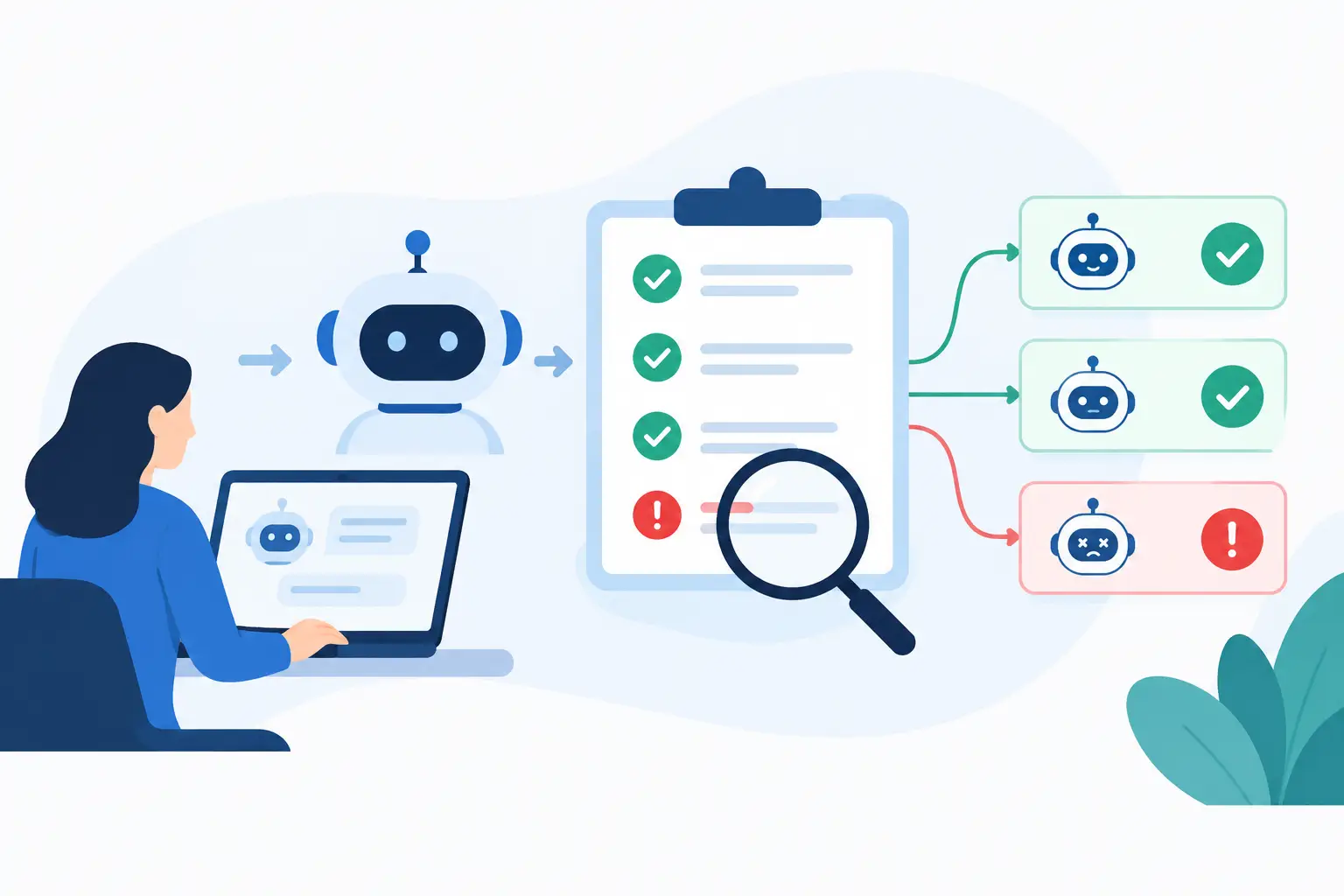
Build an AI agent evaluation framework that tests correctness, permissions, approvals, and business outcomes before a bad output reaches users safely.
A customer-facing agent gives a confident answer about a contract clause that does not exist. An internal operations agent approves a refund outside its authority. A sales assistant cites a stale pricing sheet. None of these are model demos gone wrong. They are production failures that an AI agent evaluation framework should catch before the agent reaches real users.
Most companies still evaluate agents informally. A team tries ten prompts, gets a few plausible outputs, and calls the agent ready. That process proves only that the agent can work under ideal conditions. It says nothing about what happens when records conflict, a user asks an ambiguous question, permissions change, or the right action is to refuse.
For organizations with established workflows, evaluation is not a final quality check. It is part of the operating system for AI.
Why prompt testing is not enough
A language model can produce a fluent answer while doing the wrong thing in several different ways. It may select an outdated source, combine facts from separate accounts, call the wrong tool, expose information the requester cannot access, or take an action that requires human approval. A generic benchmark will not reveal those failures because it does not know your data, policies, users, or commercial risk.
The question is not, "Is this model intelligent?" The question is, "Can this named agent perform this defined job within its authority, using the right evidence, every time it matters?"
That distinction changes how you build. An agent that summarizes project updates has a different risk profile from one that changes shipment dates or drafts responses to a regulator. The first may tolerate an occasional imperfect phrasing. The second needs strict source selection, approval controls, auditability, and a low tolerance for unsupported claims.
A useful evaluation program therefore starts with the workflow, not the model. Define the decision, action, or output the agent owns. Define the systems it may access. Define who can use it. Define when it must stop and hand work to a person.
The AI agent evaluation framework: test the whole system
An agent is more than a prompt connected to a model. It is a system made up of instructions, retrieval, tools, identity, permissions, workflow logic, approval gates, and user interface. Your evaluation framework must test that whole system.
Start by writing an agent contract. This is a short, operational document that states the agent's job, allowed inputs, approved sources, permitted actions, escalation rules, and measurable success criteria. If the team cannot write this clearly, the scope is not ready for production.
For example, an insurance operations agent might be allowed to extract policy data from a defined document set, identify missing fields, and prepare a case summary. It should not determine coverage, change a policy record, or send a customer decision. Those are not minor implementation details. They are boundaries that can be tested.
The framework should evaluate four layers together:
- Output quality: Is the response correct, complete, appropriately formatted, and useful for the task?
- Grounding and retrieval: Does the agent use approved, current sources and attach evidence where the workflow requires it?
- Control compliance: Does it respect user identity, data permissions, action limits, and required approvals?
- Operational performance: Does it complete the workflow within an acceptable time, cost, and failure rate?
A response can pass the first layer and fail the other three. That is why polished demos are a poor readiness signal.
Build a test set from real work
The fastest route to meaningful evaluations is not inventing hundreds of artificial questions. It is collecting representative cases from the work your team already does. Use completed support tickets, project documents, intake forms, transaction exceptions, and recurring internal requests. Remove or protect sensitive data as required, then label the expected result.
Include normal cases, but do not stop there. Your test set needs difficult cases: conflicting documents, missing information, stale records, requests from users with different permission levels, instructions hidden in uploaded files, and tasks that should be escalated rather than completed.
A good set also contains negative tests. Ask for information the user should not see. Request an action outside the agent's scope. Provide a document that looks authoritative but is not in the approved knowledge base. The expected behavior is not a better answer. It is a refusal, an escalation, or a request for clarification.
For each case, record the source evidence, expected outcome, acceptable variation, and severity if the agent gets it wrong. A formatting issue might be low severity. Sending a payment instruction to the wrong recipient is not.
Score what matters, not what is easy to count
Some evaluation signals are programmatic. Did the agent call the correct system? Did it include a source citation? Did it avoid an unauthorized record? Did it send the task to human review? These checks should be automated wherever possible.
Other signals require judgment. Is the summary materially accurate? Did the response interpret the policy correctly? Would an experienced case manager accept the draft without substantial rework? Use a structured human review rubric for these questions. Avoid vague labels such as "good" or "helpful." Define observable criteria and score against them consistently.
Do not collapse every result into one impressive-looking accuracy score. A 94% score can be unacceptable if the remaining 6% includes high-severity permission failures. Report results by failure class and severity. Leaders need to see whether the agent is occasionally verbose or occasionally unsafe. Those are different decisions.
It also depends on the workflow's economics. An internal research agent may justify a lower pass rate if it saves substantial time and keeps a person in the loop. An agent that communicates pricing or legal terms externally should have tighter thresholds and narrower authority.
Make approval gates part of the evaluation
Human approval is often treated as a temporary workaround. It is better understood as a designed control. The question is not whether humans are involved. The question is exactly where their judgment creates value and where the agent can safely reduce repetitive work.
Test the handoff itself. Does the reviewer receive the relevant evidence, proposed action, confidence signal, and reason for escalation? Can the reviewer correct the result without starting over? Is the approval recorded? If a reviewer cannot quickly understand what the agent did and why, the control will become a bottleneck or get bypassed.
Approval thresholds should reflect consequences. A recruiting agent may draft outreach freely but require approval before sending. A finance agent may classify invoices automatically but require review for exceptions above a value threshold. A customer service agent may answer source-backed policy questions but escalate complaints involving refunds, threats, or regulated claims.
This is where named identity and permissions matter. Every agent should have a defined role in your systems, not a shared superuser account. Evaluation must verify that the agent cannot reach data or actions outside that role, even when prompted to do so.
Run evaluations before release and after every change
Agent behavior changes when you alter prompts, retrieval settings, tool schemas, source documents, models, or permission rules. Treat those changes as software releases. Run the relevant evaluation suite before deployment, compare results against the current production baseline, and investigate regressions.
This does not require testing every conceivable scenario on every change. It requires a disciplined split. Maintain a fast regression set for routine releases, a broader release set for significant changes, and targeted tests whenever a production incident exposes a new failure mode.
Production monitoring then closes the loop. Track source usage, tool errors, escalation rates, reviewer overrides, completion time, cost per completed task, and user-reported failures. Sample real conversations and outputs for review, particularly for high-risk workflows. A system can pass its original test set while failing because the business process, documents, or user behavior changed.
When an incident occurs, do not merely patch the prompt. Classify the root cause. Was the source missing? Was retrieval poorly scoped? Did the tool return ambiguous data? Was the policy boundary unclear? Add the case to the evaluation set, fix the underlying control, and rerun the affected suite. That is how the system becomes more reliable over time.
Tie quality thresholds to a business decision
An evaluation framework is not valuable because it produces dashboards. It is valuable because it tells you whether to expand, restrict, redesign, or stop an agent.
Before building, agree on the decision criteria. A document-processing agent might need to reduce handling time by 40%, maintain a defined extraction accuracy on critical fields, and send uncertain cases to a reviewer. If it cannot meet those thresholds after a reasonable iteration cycle, do not force deployment because the demo was promising.
This is also why isolated pilots fail. A one-off agent may be evaluated once, then decay as source material and processes change. A shared AI foundation makes it practical to reuse identity controls, source attribution, evaluation tooling, and approval patterns across agents. The cost of the second and third production agent should fall because the controls already exist.
TwoHundred.ai treats evaluations as a first-class part of that foundation, not a slide at the end of delivery. The aim is not to claim that an agent never fails. No serious team can make that claim. The aim is to know how it fails, prevent unacceptable failures, and keep authority proportionate to proven performance.
Start with one workflow where errors, rework, or slow response are already visible. Give the agent a narrow job, a named owner, explicit limits, and a test set drawn from real work. If you cannot explain how you will measure a bad outcome before launch, you are not ready to give the agent a good outcome in production.
Related implementation paths
AI implementation services
Turn the article into a scoped first system with clear ownership, data, and measurement.
AI agent development company
Design agents around jobs, tools, approval points, and measurable business outcomes.
AI workflow automation
Automate one operational workflow inside the tools the team already uses.
Imraan, Founder of twohundred
Working through one of these decisions?
Book a 30-minute call. We will look at the specific workflow you are trying to put AI into, and what it would actually take to make it work in production.
Book a call